



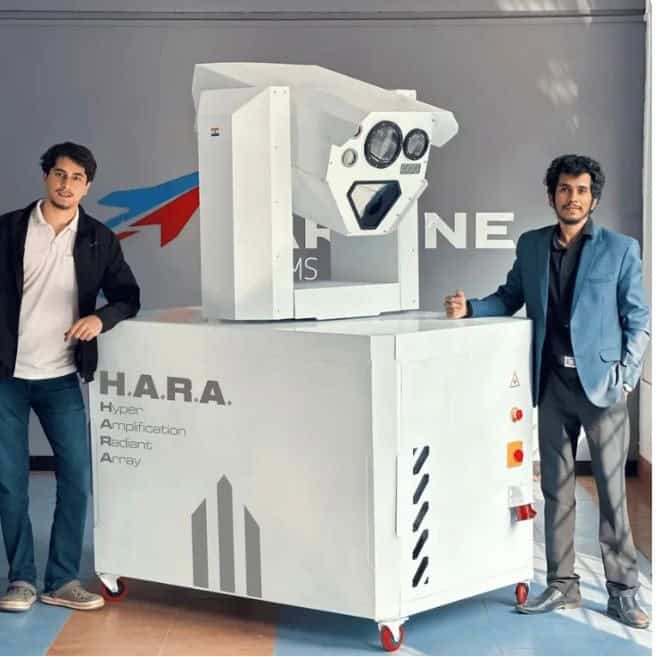
Carbine Systems, a homegrown aerospace and defence startup, has completed indoor proof-of-concept tests of H.A.R.A. Mk 1 (Hyper Amplification Radiant Array) — a 10 kW-class directed-energy weapon prototype. This is the first time a privately developed high-energy laser weapon has been designed and tested in India from first principles, entirely outside the public-sector defence labs.
The breakthrough stems from a modest yet focused R&D setup in Belagavi, underscoring how the city’s engineering ecosystem is steadily transitioning beyond conventional manufacturing into deep-tech and defence innovation.
From Belagavi, For Strategic India
Founded in 2023 by brothers Girish Joshi and Kedar Joshi, Carbine Systems began its journey in laser-based additive manufacturing for aerospace components. Girish holds a B.Tech degree in Electronics and Communication Engineering, while Kedar is a physicist from the National Institute of Technology, Karnataka.

The startup was incubated last year at KLS GRID (GIT’s Research Innovation and Development), where it was among the first few ventures to receive dedicated floor space exclusively for R&D.
The founders said the shift towards defence technologies was driven by real-world urgency rather than boardroom strategy.
“After the drone-related security threats of 2025, it became clear that there were serious capability gaps,” the founders said. “We realised the time for only writing proposals was over. The time had come to build, test and prove.”
Bootstrap Engineering, Belagavi Style
Despite early technical submissions to institutional stakeholders not converting into funded programmes, the team chose to move ahead using what they describe as “bootstrap engineering”.
“We decided to execute with whatever resources we had,” they said. “H.A.R.A. Mk 1 is not a paper concept. It is the outcome of years of work in laser–matter interaction, thermal control and beam stability, now demonstrated as a working platform.”
The H.A.R.A. Mk 1 is designed for a 1–2 km engagement range and uses proprietary Coherent Beam Combining (CBC) technology along with advanced thermal management systems. These capabilities were originally developed for high-energy manufacturing applications and later adapted for defence use.
January 2026 Tests: Proof on the Table
The January 2026 indoor trials involved engaging multiple target objects under controlled conditions to validate beam stability, energy delivery and system reliability. According to the company, the tests met all internal performance benchmarks.
Key highlights include:
- Precision-aligned laser arrays using proprietary CBC architecture
- AI-driven beam quality monitoring
- A largely indigenous supply chain, developed without venture capital or institutional funding
This, the founders say, reflects the latent strength of the Belagavi manufacturing and engineering ecosystem.
What’s Next for Carbine Systems
Carbine Systems is now setting up a dedicated Laser R&D facility in Belagavi, aiming to tap into the region’s pool of precision engineers and fabrication specialists.
Looking beyond defence, the company’s roadmap includes work on:
- Megawatt-class laser systems for renewable energy research
- Supercontinuum free-electron lasers
- Advanced photonics applications linked to next-generation nuclear fusion research
“With H.A.R.A. Mk 1, we are proving that deep-tech defence innovation does not have to be confined to government laboratories,” the founders said. “Belagavi can build world-class strategic hardware. This is about moving from intent to execution.”
A Quiet Milestone, With Long-Term Impact
While there was no grand launch or fanfare, Carbine Systems’ achievement marks a significant moment — not just for the startup, but for Belagavi’s evolving identity as a serious technology and innovation hub.
From workshop floors to weapon-grade photonics, Belagavi’s engineering story has just entered a much brighter — and more powerful — chapter.