




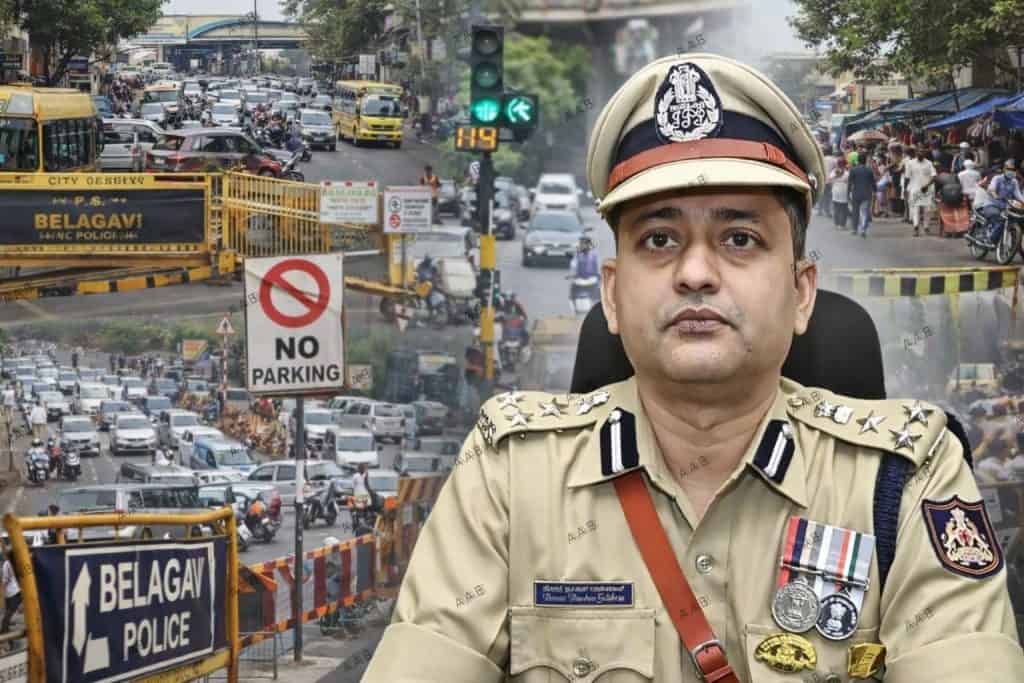
The Belagavi city police have intensified efforts to ease traffic congestion across key junctions and market areas, with a mix of restrictions, enforcement, parking reforms and technology-driven solutions now showing visible results.
Addressing the media, Police Commissioner Borase Bhushan Gulabrao said several corrective steps have already been implemented. Heavy vehicles have been banned during peak hours — from 7 am to 11 am and 3 pm to 8 pm — while private buses have been shifted to designated parking areas near Dharmanath Circle and Bharatesh College, following cooperation from operators.
Strict enforcement has also been stepped up, with cases being booked daily against 15–20 Heavy vehicles for violating rules. Barricades installed near Market Police Station have enforced lane discipline, while no-parking zones opposite the Forest Office have helped ensure smoother vehicle movement despite road narrowing.

Parking continues to remain a major challenge in market areas. To address this, the police have urged four-wheeler users to utilise the basement parking at the New City Bus Stand, where full-day parking costs just ₹10. Pedestrian access has also been ensured through dedicated barricade openings.
Looking ahead, Borase said the police plan to introduce one-way traffic systems in multiple parts of Belagavi and extend lane discipline through additional barricading. Talks are underway with tradersof the area for one way and also to introduce odd-even parking, while efforts are being made to identify nearby private parking spaces to reduce roadside congestion.
School and college parking has emerged as another concern. While Bharatesh College has cooperated, the Commissioner said fresh appeals will be made to other institutions to allow parking within their premises. The police have also sought permission from KPTCL to use its vacant land as paid parking, which is awaiting approval.
On the technology front, a comprehensive traffic study by a Bengaluru-based agency has recommended major upgrades. Of the city’s 23 traffic signals, only 13 currently operate with timers, while others are in blinker mode. The police aim to activate 20 timer-based signals by the end of February, along with installing additional signals where required.
Further, video-activated smart signals have already been installed at eight junctions, with plans to expand this to 16–18 locations. These systems dynamically adjust signal timing based on real-time traffic flow.
A pedestrian movement survey revealed that the Central Bus Stand area is the most hazardous, with nearly 11,000 pedestrians crossing in 12 hours, followed by Rani Channamma Circle. The study recommends elevated pedestrian corridors with lifts, as foot overbridges without lifts see poor usage.
“Traffic management cannot be done by police alone,” Borase said, appealing to citizens to cooperate by following parking rules and maintaining lane discipline. “The response so far has been encouraging, and congestion is slowly reducing.”
We sincerely applaude the efforts of the police dept towards making Belagavi city roads safer for driving as well as for pedestrians. I request the Commissioner to consider the following: –
(a) At the Second Railway Gate, prevent the vehicles on either side of the Gate from rushing to cross as soon as the Gate opens. This requires a policeman near the Maruti Temple and another one towards Eastern side of the Gate to be positioned after the barrier is lowered. Traffic should be allowed only from one side of the Gate after the barrier is lifted.
(b) At the road junction on Khanapur Road near Foundry Cluster, there is a requirement to position a policeman from 9 am to 12 pm and from 6 pm to 7:30 pm to ensure smooth flow of traffic and avoid accidents.