




As tensions in West Asia disrupt global energy supply chains, India once again finds itself vulnerable to fluctuations in LPG availability and pricing. Reports of cylinder shortages and delayed refills are emerging from several regions, including parts of Belagavi. For most households, the kitchen has become the first place where geopolitical instability is felt.
But just 20 km away from Belagavi, the village of Kattanbhavi presents a striking contrast — one that policymakers may have overlooked for decades.
Here, nearly 80% of households are not dependent on LPG at all.

A Village That Opted Out of the Crisis
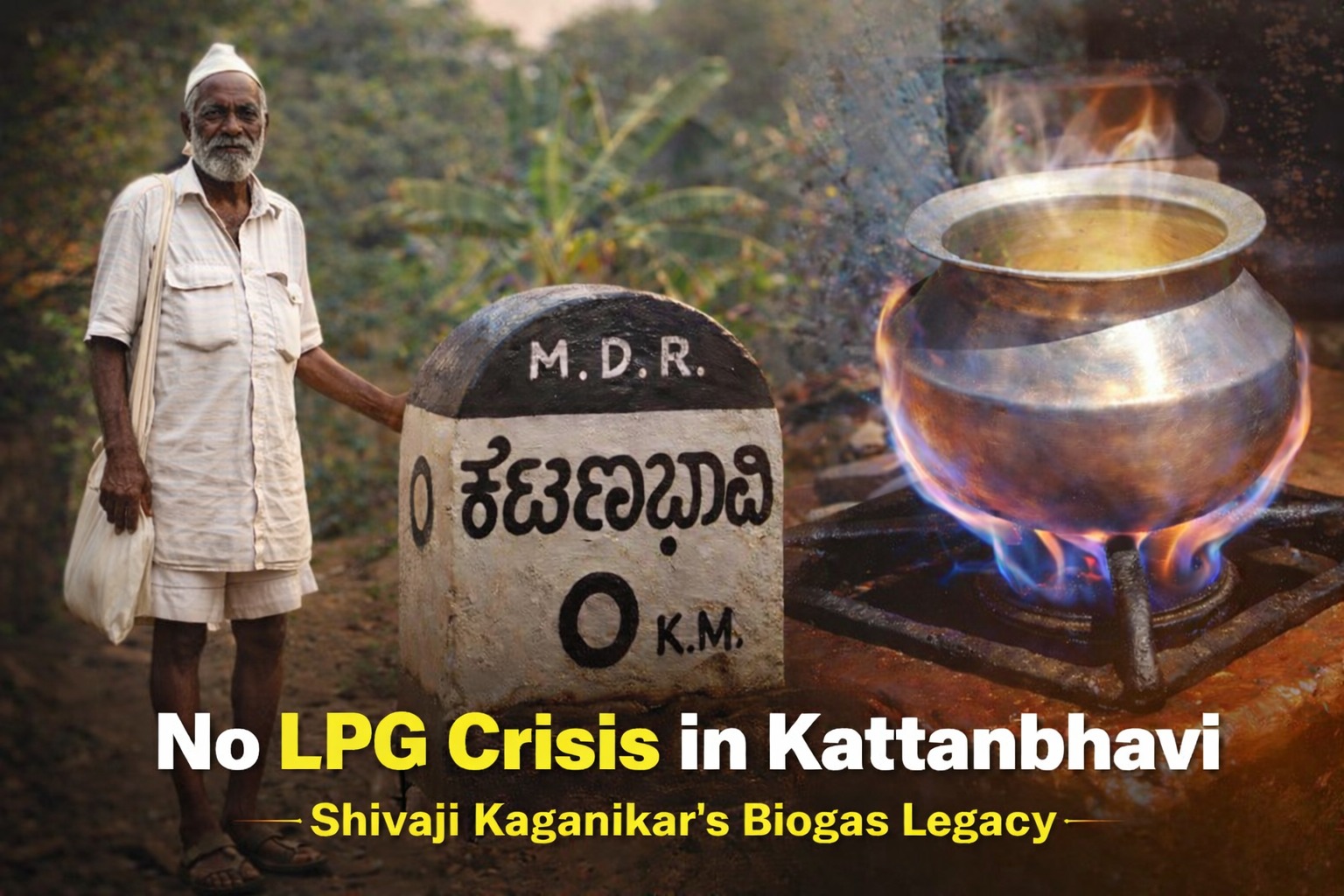
Kattanbhavi’s resilience is not accidental. It is the result of a quiet, sustained movement led by social worker Dr.Shivaji Kaganikar over three decades ago. At a time when LPG penetration itself was limited and renewable energy was not part of mainstream discourse, Kaganikar was already walking door-to-door convincing villagers to adopt gobar gas units.
Today, most homes in this village of around 1,200 people run on biogas systems installed 30–35 years ago — many of which are still functional.
Residents speak with a sense of calm detachment from the ongoing LPG concerns.
“We keep reading about LPG shortage in Belagavi and Hukkeri. But we are not worried. Few people have cylinders here,” says villager Bhairavnath Kothekar.
This is not just energy independence — it is insulation from global volatility.
Ahead of Its Time
Kaganikar’s intervention began in the early 1990s when he arrived in Kattanbhavi to run a school for dropouts. What he observed then was a familiar rural pattern: rampant cutting of trees for firewood, declining green cover, and rising pressure on natural resources.
Instead of waiting for policy or subsidies, he turned to a simple, locally available solution — cattle dung.
With training from institutions like Khadi Gram Abhivruddhi Sangha and support from Jana Jagarana Samsthe, he began promoting “Deena Bandhu” biogas units. These systems converted animal and human waste into clean cooking fuel through underground pipelines, eliminating the need for firewood and later LPG.
Convincing villagers was not easy.
There was skepticism, lack of awareness, and a perception that such technology was only for large farmers. Kaganikar and his team countered this through relentless grassroots engagement — visiting every household, demonstrating benefits, and ensuring financial and technical support.
The result: a behavioural shift at scale.
More Than Just Fuel
What Kattanbhavi built was not merely an alternative energy system — it was a circular rural economy model.
Biogas units brought multiple benefits:
- Clean cooking fuel, eliminating smoke-filled kitchens
- Organic slurry that improved soil fertility
- Increased livestock rearing, boosting rural income
- Better sanitation through integration with toilets
- Reduced dependence on forests and external fuel sources
Even as technology evolved, the village adapted. Newer, compact units now occupy less than a square metre and can be installed at relatively low cost — as little as ₹25,000 in some cases.
Maintenance remains simple and community-driven.
“We put a bucket of slurry in the morning and another in the evening. There is no need to do anything else,” says homemaker Mallavva Pavale.
Scale Beyond One Village
Kaganikar’s work did not stop at Kattanbhavi. Over the years, he and his network of volunteers have reportedly convinced around 20,000 farmers across Belagavi district to adopt biogas systems.
Villages across Hukkeri, Khanapur and surrounding regions saw similar transitions, creating pockets of decentralised energy resilience long before the term became fashionable.
The Policy Blind Spot
Despite decades of success, such models remain peripheral in India’s energy planning. LPG continues to dominate rural cooking policy, heavily subsidised and centrally distributed — but also vulnerable to global shocks.
The current West Asia crisis has once again exposed this structural fragility.
Kattanbhavi, on the other hand, demonstrates what true energy security looks like:
- locally sourced
- community-managed
- environmentally sustainable
- geopolitically insulated
A Lesson Rediscovered
Shivaji Kaganikar did not wait for a crisis to act. He anticipated one — not in geopolitical terms, but in ecological and social terms — and responded with what was available at hand.
Thirty years later, as LPG supply chains strain and prices fluctuate, his work appears not just relevant, but prescient.
The question is no longer whether biogas works.
The real question is: Why did it take a global crisis for us to notice what a small village had already solved decades ago?
Source: ETV Bharat, The Hindu
Nicely covered the #Sustainable work efforts of Dr. Shivaji Kaganikar. Keep up.