



Belagavi could emerge as Karnataka’s renewable energy capital, South-West India’s largest data centre destination, an electric mobility hub and a globally connected manufacturing city by 2047, if the vision presented by MP Jagadish Shettar takes shape.
At a recent stakeholder consultation chaired by the Belagavi MP, a series of detailed concept boards outlined an ambitious roadmap for the city’s future. The presentations went far beyond conventional infrastructure proposals and envisioned a complete transformation of Belagavi’s economy over the next two decades.
The concept revolves around creating a sustainable, technology-driven and globally competitive city while leveraging Belagavi’s strengths in manufacturing, agriculture, education and its strategic location.

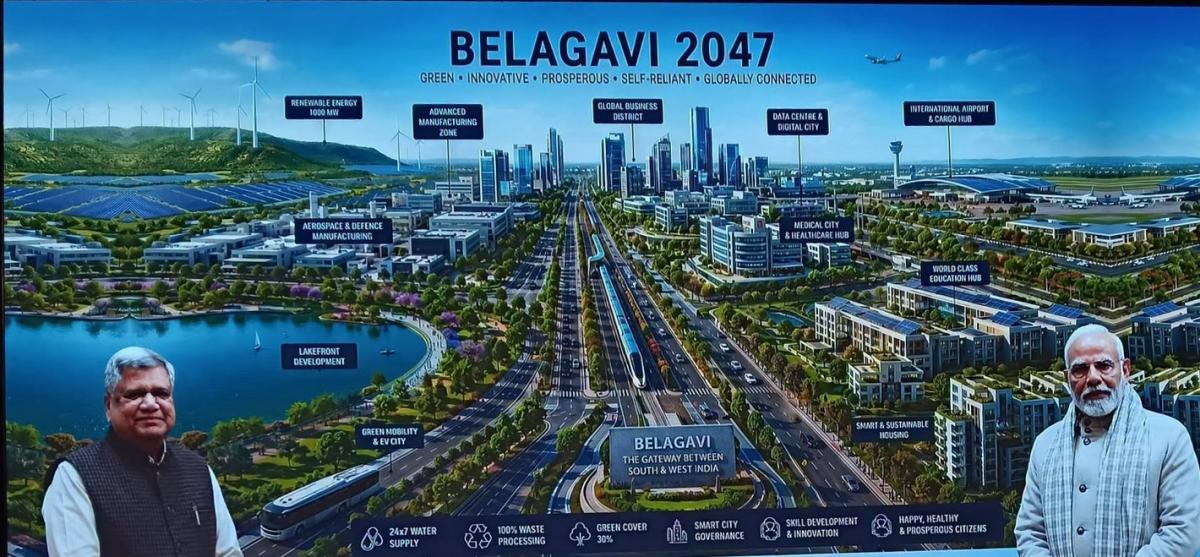
Belagavi 2047: The Big Picture
The master vision projects Belagavi as:
- Renewable Energy Hub (1,000 MW capacity)
- Advanced Manufacturing Zone
- Global Business District
- Data Centre & Digital City
- International Airport & Cargo Hub
- Medical City & Healthcare Hub
- World-Class Education Hub
- Aerospace & Defence Manufacturing Cluster
- Green Mobility & EV City
- Smart and Sustainable Housing
- Lakefront Development
The city is envisioned with:
- 24×7 drinking water supply
- 100% waste processing
- 30% green cover
- Smart city governance
- Skill development ecosystem
- Happy, healthy and prosperous citizens
Data Centre Energy Security Mission
One of the biggest proposals is positioning Belagavi as South-West India’s Data Centre and AI Infrastructure Hub.
Proposed initiatives
Data Centre Corridor
A dedicated corridor near Belagavi Airport is proposed because of:
- Availability of land
- Airport connectivity
- National Highway access
- Railway connectivity
- Low congestion
Renewable Power Infrastructure
To support data centres, the proposal includes:
- 150 MW renewable power capacity
- Dedicated solar parks
- Battery storage systems
- Dual independent power supply
- Gas-based emergency backup
Green Data Centres
The vision also proposes:
- Solar-powered campuses
- Battery storage
- Waste heat recovery
- Water recycling
- LEED and IGBC certified facilities
Digital Infrastructure
Plans include:
- Multiple fibre routes
- Internet Exchange Node
- Edge computing facilities
- Connectivity to Mumbai, Bengaluru, Hyderabad and Chennai
AI Ecosystem
Dedicated facilities for:
- AI compute clusters
- GPU data centres
- AI research centres
- Startup innovation ecosystem
Economic Impact
Projected outcomes include:
- ₹15,000–20,000 crore investment
- 5,000–10,000 direct jobs
- 20,000+ indirect jobs
Target:
- 100 MW IT load by 2047
Biomass & Agri-Energy Mission
Belagavi’s agricultural strength forms the basis of another major proposal.
Instead of treating agricultural waste as residue, the vision proposes converting it into energy.
Biomass Sources
Potential feedstock includes:
- Sugarcane trash
- Bagasse
- Maize residue
- Agricultural waste
- Animal waste
- Horticulture waste
Estimated renewable energy potential:
- 50 MW
Bio-CNG Network
A district-wide Bio-CNG ecosystem is proposed using:
- Agricultural waste
- Market waste
- Dairy waste
- Poultry waste
Applications include:
- City buses
- Garbage trucks
- Commercial vehicles
- Hotels and industries
Target production:
- 20–30 tonnes per day
Biomass Power Plants
Distributed biomass plants located close to feedstock sources are proposed to reduce transportation costs and strengthen rural economies.
Sugar Industry Integration
The proposal suggests:
- Cogeneration plants
- Bagasse-based electricity generation
- Ethanol production
Farmer Energy Cooperatives
Farmers would directly participate by supplying:
- Crop residue
- Biomass
- Organic waste
This aims to generate additional farm income while creating a circular rural economy.
Expected Benefits
- ₹500–1,500 crore additional farmer income
- 10,000 direct jobs
- 25,000 indirect jobs
Electric Mobility Energy Mission
The third major pillar is making Belagavi an electric mobility city.
Public Transport
Vision includes:
- 100% electric city bus fleet
- More than 500 electric buses
- New electric bus depots across the city
EV Charging Infrastructure
Plans include:
- Over 500 public charging stations
- Fast chargers along NH-48 and Airport Corridor
- Bus charging stations
- Mandatory residential EV-ready buildings
Renewable-powered Charging
Charging stations powered through:
- Solar rooftops
- Battery storage
- EV charging parks
Government Fleet Electrification
Complete electrification of government vehicles.
Focus also extends to:
- Auto-rickshaws
- Taxis
- Delivery vehicles
- Municipal vehicles
Logistics Electrification
Dedicated electric truck charging hubs and green freight corridors are proposed.
Smart Mobility Platform
Integrated digital management for:
- Charging stations
- Vehicle movement
- Fleet monitoring
- Smart payments
Targets by 2047
- 500+ electric buses
- 500+ charging stations
- 100+ fast chargers
- 100% government fleet electrification
- 75 MW EV energy demand support
Beyond Individual Projects
The presentations also show every mission being interconnected.
For example:
- Renewable energy powers data centres.
- Agricultural waste fuels Bio-CNG.
- Smart grids support electric mobility.
- Logistics infrastructure complements airport expansion.
- AI infrastructure supports manufacturing and digital industries.
Rather than isolated projects, the concept proposes an integrated economic ecosystem.
The Vision at a Glance
If implemented, the Belagavi 2047 roadmap seeks to establish the city as:
- South-West India’s Data Centre Hub
- Karnataka’s Bio-Energy Capital
- Electric Mobility City
- Global Manufacturing Centre
- Renewable Energy Hub
- Logistics and Cargo Gateway
- Healthcare and Education Destination
- Aerospace and Defence Manufacturing Cluster
- Smart, sustainable and globally connected city
While these remain conceptual proposals at present, they provide the clearest indication yet of the long-term development agenda MP Jagadish Shettar intends to pursue for Belagavi over the next two decades. The challenge now will be translating this ambitious vision into funded projects, policy support and on-ground execution.
Vision without action plan is a dream
Dreams come true only when one wakes up and works towards making them true
Our best wishes to those in the driver’s seat to implement the vision with visible action on ground
One step at a time
How about clearing up the garbage to install confidence amongst the naysayers