




Belagavi’s railway line has long been both a transport asset and an urban barrier. Between the 4th Gate and Gandhinagar Gate, the track runs through a densely built stretch with neighbourhoods on both sides, and every level crossing adds another pressure point to traffic, access, and safety.
At the same time, Belagavi is already seeing how slow big infrastructure can be. The city’s proposed flyover from Hotel Sankam to Dharmaveer Sambhaji Maharaj Chowk has received administrative approval. However, the plan is still moving through public consultation, phased alignment, and tender preparation before construction begins. The project is officially being treated as a phased corridor, with the first stretch to be taken up after stakeholder feedback is finalised.
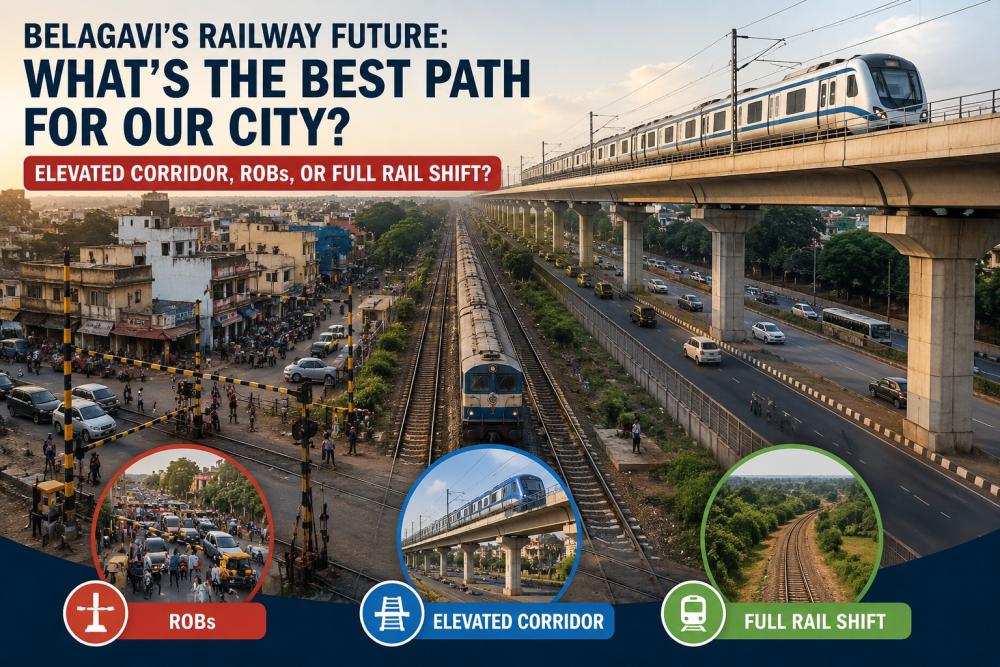
That raises a broader civic question: should Belagavi continue addressing each railway crossing one by one with ROBs, or plan a larger solution, such as an elevated railway corridor? And if the city is thinking long-term, should the railway line itself be shifted outside the urban core instead?

What the city is really asking
A 9-km elevated railway corridor would, in theory, remove level crossings from the dense city stretch in one stroke. That means uninterrupted road movement, fewer gate closures, and no fresh conflict every time a new ROB is proposed.
But the same project would also mean a major construction footprint, long utility shifting, access changes for nearby homes and businesses, and a much larger cost and approval process than a single ROB. The key question for citizens is not whether the idea looks attractive on paper. It is whether Belagavi is ready for the time, money, and disruption such a corridor would bring.
Examples from elsewhere in India
India has already built elevated rail systems in high-density urban conditions.
Kurukshetra Elevated Track is constructed to bypass the city’s 5 manned level crossings in heart of Kurukshetra City. with a cost of ₹ 245.99 Crore. 2. Nagpur Double Decker Integrated Road cum Metro corridor, 44 km of Elevated Track eliminating all the level crossings with an estimated cost of ₹ 9,279 Crore.
These examples show that elevated rail is not an alien concept in India. The harder question is whether Belagavi’s scale, land pattern, and finances make a similar solution realistic for a conventional city rail corridor.
Why a full railway shift is a different proposition
A complete shift of the railway line outside the city would be even more complex than an elevated corridor.
Belagavi’s separate Belagavi–Dharwad via Kittur line is already a sanctioned new line, not a city bypass. South Western Railway’s 2020 press release says the 73-km project was sanctioned at an estimated cost of Rs 927.40 crore, while an earlier SWR update says the final location survey for the 90-km Dharwad-Kittur-Belagavi alignment was included in the 2019-20 budget. SWR also said the new line would reduce the Belagavi-Dharwad distance by 31 km.
That project improves regional connectivity. It does not, by itself, remove the existing railway barrier inside Belagavi city. So a true “railway shift” would mean a fresh outer alignment, fresh land acquisition, new station planning, and a transition strategy for the existing urban line. In practical terms, that is not a small modification; it is a separate city-defining project.
SWOT analysis
| Option | Strengths | Weaknesses | Opportunities | Threats |
|---|---|---|---|---|
| 9-km elevated railway corridor | Removes level crossings across the core stretch; improves uninterrupted movement; solves multiple gate conflicts at once | Very high cost; long construction period; heavy disruption in a dense built-up area; complex utility shifting | Could unlock road redesign, public spaces, service roads, and better mobility around the corridor | Funding uncertainty; project delays; resistance from residents and traders; land and access disputes |
| Full railway shift outside the city | Removes the rail barrier from the urban core; frees central land for city redevelopment | Highest complexity; requires a new alignment and major land acquisition; long approval cycle | Can create a long-term urban reset if a bypass line becomes a true replacement corridor | Very difficult to execute; political and financial risk; transitional operational problems |
| ROB-based solution | Faster, more familiar, and cheaper than a rail shift; can be taken up crossing by crossing | Solves only specific points; does not remove the overall city barrier; can hurt access and local businesses near the structure | Can be phased according to traffic intensity and urgency | Public opposition; traffic diversion during construction; limited long-term value if crossings remain many |
How much time could each option take?
These are rough planning estimates, not official timelines.
A major ROB can often be built in about 2 to 4 years from final design to commissioning, depending on land, utility shifting, and traffic management. In Belagavi, the current flyover debate shows that even a city flyover needs public consultation and phased execution, which can stretch the schedule further.
A 9-km elevated railway corridor in a dense city stretch could realistically take 5 to 8 years or more, because it would need detailed survey work, approvals, land and utility coordination, staging of construction, and likely traffic diversions through much of the route.
A full railway shift outside the city would likely be an 8 to 15+ year effort, and possibly longer, because it is not just a rail structure but an entirely new alignment, with land acquisition, operational transition, and parallel infrastructure planning.
The citizen’s test
Belagavi does not just need a technically correct answer. It needs a socially workable one.
Should the city accept a corridor of ROBs and flyovers, each solving one crossing but leaving the overall rail divide intact? Or should it begin discussing a one-time, high-cost, high-disruption elevated corridor that could eliminate the city’s level-crossing problem more comprehensively? Or is the best long-term answer to keep the rail line outside the urban core altogether, even if that means a much longer wait?
For a city growing on both sides of the track, the real decision is not only about engineering. It is about what kind of Belagavi citizens want in 10 years, 20 years, and beyond.
The existing railway line is the main issue, and the city has built around the line. The time and cost of building ROB may not be feasible since there is no space for third line for future. The best option would be to lay a parallel railway line to the new Halga Macche bye pass road since it can be easily aligned with new Dharwad line , whenever it happens . This may not disrupt city traffic. The only challenge would be to get the land for it , however it would be easier than getting land in city area
Shift the railway line completely out of the city with space provision for overbridges in future for the new line too.City growth is bound to catch up with the new railway station.
With the new bullet trains going in straight lines, it’s obviously going to redefine rail travel with new stations and travellers opting for the bullet trains rather than the 🐌 snail trains
What will remain is a nostalgic rail line, with people still enjoying the wait for the train to pass through their city and meet their friends in sahapur yet the gen z will be reaching Kolhapur and Hubli in bullet train in the same time
The Amrit kaal at its imaginative best the former remains a reality the latter will be viewed by NRIs through AI generated reality
The railway track should be taken out of the city. City should be bypassed. Construct a railway track from Sambra to 4th gate & Belgaum railway station should be at the point of intersection of railway track & Yellur road.
ಬೆಳಗಾವಿಗೆ ಈ ಫ್ಲೈ ಓವರ್ ಅವಶ್ಯಕತೆ ಇದೆಯೇ?!!
Does Belagavi need this flyover?!!
ಈಗಾಗಲೇ ನಗರದ ಸುತ್ತ ರಿಂಗ್ ರೋಡ್ ನಿರ್ಮಾಣವಾಗುತ್ತಿದ್ದು, ಅದರಿಂದ ನಗರದ ಒಳಗಿನ ಅರ್ಧದಷ್ಟು ಟ್ರಾಫಿಕ್ ಕಡಿಮೆ ಆಗುತ್ತದೆ.
500 ಕೋಟಿ ರೂಪಾಯಿ ಖರ್ಚು ಮಾಡಿ ಫ್ಲೈ ಓವರ್ ಮಾಡುವ ಬದಲು ಅದರ ನಾಲ್ಕಾಣೆ ಭಾಗದ ಹಣದಲ್ಲಿ ಸುವರ್ಣ ಸೌಧ ಸಮೀಪದಲ್ಲಿ ಅಥವಾ ಇನ್ನೊಂದು ಕಡೆ ಆಡಳಿತದ ಬಹುಮಹಡಿ ಕಟ್ಟಡ ಕಟ್ಟಬಹುದು ಮತ್ತು ನ್ಯಾಯಾಲಯದ ಬಹುಮಹಡಿ ಕಟ್ಟಡ ಕಟ್ಟಬಹುದು. ಇದರಿಂದ ನಗರದಲ್ಲಿ ಟ್ರಾಫಿಕ್ ಸಮಸ್ಯೆ ಇರುವುದಿಲ್ಲ.
ಆದರೆ ಈ ಫ್ಲೈ ಓವರ್ ಕಟ್ಟಲು ಹೋದರೆ ನಿರ್ಮಾಣದ ಅವಧಿ ವರೆಗೆ ನಗರದ ಸಂಚಾರ ವ್ಯವಸ್ಥೆ ಮತ್ತು ಸೌಂದರ್ಯ ಸಂಪೂರ್ಣ ಹಾಳಾಗಿ ಹೋಗುತ್ತದೆ.
ಎಲ್ಲಕ್ಕಿಂತ ಮುಖ್ಯವಾಗಿ ಈಗಿರುವ ರಸ್ತೆಯ ಮೇಲೆಯೇ ಫ್ಲೈ ಓವರ್ ಮಾಡಿದಾಗ ಈಗಿರುವ ರಸ್ತೆಯ ಮೇಲೆ ಆಗುವ ಟ್ರಾಫಿಕ್ ಜಾಮ್ ಫ್ಲೈ ಓವರ್ ರಸ್ತೆ ಮೇಲೆ ಆಗುತ್ತದೆ ಅಷ್ಟೇ. ಅದು ಇನ್ನೂ ಹೆಚ್ಚು ತೊಂದರೆ ಮತ್ತು ಅಪಾಯಕಾರಿ.
ಈಗಾಗಲೇ ಹುಬ್ಬಳ್ಳಿಯಲ್ಲಿ ಈ ರೀತಿ ಮಾಡಲು ಹೋಗಿ ಏನಾಗಿದೆ ನೋಡಿ.
ಆದ್ದರಿಂದ ಸಂಪೂರ್ಣ ರಸ್ತೆಯ ಮೇಲೆ ಫ್ಲೈ ಓವರ್ ಮಾಡುವ ಬದಲು ಇರುವ ರಸ್ತೆಯನ್ನು ಸಾಧ್ಯವಾದಷ್ಟು ಅಗಲ ಮಾಡಿ, ಅಥವಾ ಅಶೋಕ ಸರ್ಕಲ್ ನಂತಹ ಅವಶ್ಯಕತೆ ಇರುವಲ್ಲಿ ಮಾತ್ರ ಫ್ಲೈ ಓವರ್ ಮಾಡುವ ಮೂಲಕ ಟ್ರಾಫಿಕ್ ಸಮಸ್ಯೆ ಬಗೆಹರಿಸಬಹುದು..
ದಯವಿಟ್ಟು ಎಲ್ಲರೂ ಈ ಕುರಿತು ಯೋಚಿಸಿ.