



The India Meteorological Department’s (IMD) latest seasonal outlook for the 2026 Southwest Monsoon indicates that Belagavi falls within a broad region where below-normal rainfall is currently considered more likely than normal or above-normal rainfall.
In its crucial second-stage forecast released on May 29, the IMD lowered its country-wide seasonal rainfall projection to 90% of the Long Period Average (LPA), down from its April estimate of 92%. This shift is largely driven by a rapid transition toward El Niño conditions in the equatorial Pacific, which historically suppresses monsoon activity as the season progresses into August and September.
The forecast map shows much of South Peninsular India, including the border areas of Karnataka and Goa where Belagavi sits (near 15°N latitude and 75°E longitude), shaded in a yellow zone.

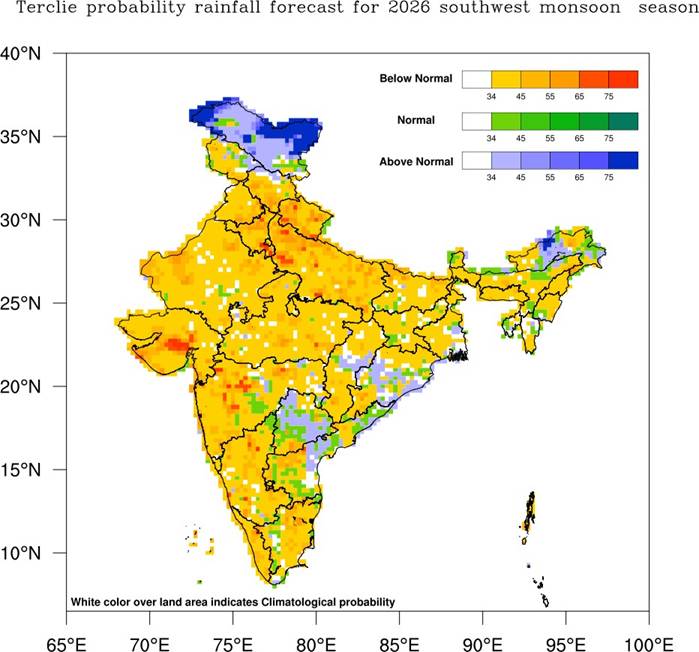
According to the IMD’s regional multi-model ensemble:
- 45% probability of below-normal rainfall
- 34% probability of normal rainfall
- 21% probability of above-normal rainfall
However, weather experts caution that this should not be interpreted as an outright prediction of drought. A 45% probability simply means that among the possible rainfall scenarios generated by climate models, below-normal is the single most likely outcome. There remains a combined 55% probability that the region could still see a normal or even above-normal monsoon.
For Belagavi, the forecast suggests a need for strategic planning rather than immediate alarm. Because of the district’s unique geography nestled against the Western Ghats, actual localized monsoon performance will heavily depend on real-time factors: the strength of the offshore trough, the frequency of low-pressure systems over the Arabian Sea, and how evenly the rain splits across the core months of July and August.
As with all long-range outlooks, this macro-view provides a broad seasonal trend rather than a pinpoint district forecast. A clearer picture of the monsoon’s true local impact will begin to establish itself once the opening leg of rain unfolds through June and early July.
Source: India Meteorological Department (IMD) Second Stage Monsoon Outlook, May 29, 2026.