



Clearer skies, weakening monsoon influence and a sharp drop in cloud cover are pushing Belagavi’s temperatures well above the October average — with the mercury touching 34°C on October 3
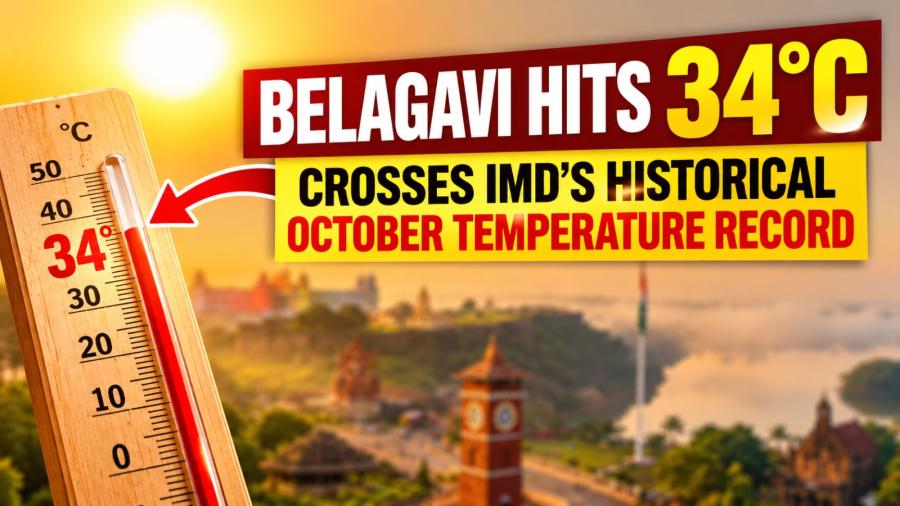
Belagavi, October 3, 2026: Belagavi has suddenly begun feeling much hotter as October gets underway, with the India Meteorological Department (IMD) recording a maximum temperature of 34°C on Saturday.
The reading is particularly notable because Belagavi’s normal October maximum temperature is 29.4°C, based on IMD’s 1981–2010 climatological data. Saturday’s temperature is therefore about 4.6°C above the long-term October average.

The 34°C reading also sits above the 33.8°C all-time October maximum currently listed by the IMD for Belagavi, recorded on October 14, 1997, and October 1–2, 2002. However, the IMD’s online historical table has not yet been updated with 2026 data, so the 34°C reading should be described as potentially a new October record pending its inclusion in the official historical series.
So, why did Belagavi suddenly become so hot?
The answer lies largely in the rapid transition from the southwest monsoon regime to the post-monsoon pattern.
For several days towards the end of September, Belagavi was still experiencing relatively cloudy conditions and forecasts of light rain. The IMD’s local forecast, for example, had temperatures around 31–33°C with generally cloudy skies and light rain around September 28–October 2.
By October 3, the picture had changed.
The current IMD forecast shown for Belagavi indicates temperatures around 33–34°C, with partly cloudy conditions. Independent weather observations also put the day’s maximum at around 34°C, with the next few days remaining in the 33–34°C range.
Fewer clouds means more heating
Cloud cover is one of the most important natural controls on daytime temperature.
When thick monsoon clouds dominate, a significant part of incoming solar radiation is reflected or absorbed before reaching the surface. Rainfall also cools the surface.
When those clouds disappear, much more solar energy reaches the ground, and the land heats rapidly during the afternoon.
That is essentially what Belagavi is experiencing now.
The city has moved from a more monsoon-like cloudy environment to one with longer periods of sunshine and much less rainfall, allowing daytime temperatures to rise sharply.
The monsoon is retreating — but has it withdrawn from Belagavi?
This requires some care.
The southwest monsoon is in its withdrawal phase, but it would be incorrect to simply say that the monsoon has completely withdrawn from Belagavi.
The IMD uses specific criteria before declaring withdrawal. These include cessation of rainfall for a sustained period, establishment of an anticyclonic circulation in the lower atmosphere and a considerable reduction in atmospheric moisture. For further withdrawal, the IMD also considers the spatial continuity of dry conditions and reduced moisture.
The IMD has been indicating further withdrawal of the southwest monsoon from parts of north and central India around October 3, while rainfall continues over several parts of southern India.
This distinction is important for Belagavi because the city can become hot and relatively dry even while parts of Karnataka continue receiving rain.
North and South Karnataka are seeing different weather
The latest IMD warning page issued on October 3 illustrates this contrast.
For North Interior Karnataka, which includes Belagavi, the IMD has issued no weather warning from October 3 through October 9.
For South Interior Karnataka, however, the IMD has forecast heavy rain on October 5 and 6.
In other words, Karnataka is not experiencing one uniform weather pattern.
While southern parts of the state can continue to receive rain, Belagavi and other areas of North Interior Karnataka can experience clearer skies and stronger daytime heating.
What about the wind?
The changing wind regime is another part of the story.
The southwest monsoon is characterised by moisture-laden southwesterly flow. As the monsoon retreats, the circulation pattern gradually changes and the supply of moisture to areas such as North Interior Karnataka reduces.
The IMD itself defines withdrawal from the southern peninsula in terms of a change from the southwesterly wind regime along with reduced moisture and persistent dry weather.
This does not mean that one particular wind direction suddenly “caused” Belagavi’s 34°C. Rather, the broader atmospheric circulation is changing, reducing the persistent moisture and cloudiness associated with the southwest monsoon.
Humidity can make the change feel confusing
There is another reason residents may feel that the weather has changed dramatically.
Monsoon weather is often humid but relatively cool during the daytime because of clouds and rainfall.
During the transition period, afternoon humidity can fall as skies clear and temperatures rise. That allows the land surface and near-surface air to heat more efficiently.
At the same time, humidity can rise again during the night and early morning.
So, high humidity and high temperature are not necessarily occurring together throughout the day.
Karnataka’s weak monsoon is an important background factor
The sudden October heat also comes against the backdrop of a very poor southwest monsoon season for Karnataka.
According to rainfall data reported from the Karnataka State Natural Disaster Monitoring Centre, Karnataka finished the June–September southwest monsoon season with around 35% less rainfall than normal, making it the state’s weakest southwest monsoon performance since 1971.
That does not mean the rainfall deficit directly caused Saturday’s 34°C temperature.
But it is important context.
A season with substantially less rainfall means that the landscape enters the post-monsoon period with less persistent wetness and fewer episodes of prolonged cloud and rain. Once the skies clear, strong October sunshine can therefore produce a rapid rise in daytime temperatures.
Is this a heatwave?
Not at this stage.
A temperature of 34°C in Belagavi may feel unusually hot, especially after weeks of monsoon-like weather, but a single high maximum does not automatically constitute an IMD heatwave.
The important comparison is with the climatological normal.
Belagavi’s normal October maximum is 29.4°C, so 34°C is substantially above normal. But the appropriate description at present is an unusually hot spell or sharp temperature rise, rather than calling it a heatwave without the relevant IMD criteria being met.
And the temperature could remain high for a few days
The current forecast suggests that the heat is unlikely to disappear immediately.
Temperatures around 33–34°C are expected through the first few days of October, while the IMD’s current warning shows no significant weather warning for North Interior Karnataka through October 9.
That does not mean there will be no rain at all. Localised showers can still occur during the transition period, and weather conditions can change quickly.
But the broader pattern currently favours warmer, sunnier afternoons in Belagavi.
The bigger picture
Belagavi’s sudden October heat is therefore not the result of a single weather system.
It is the result of several factors coming together:
- The southwest monsoon is retreating and the seasonal circulation is changing.
- Cloud cover and rainfall over Belagavi have reduced.
- More sunshine is reaching the surface during the afternoon.
- Moisture availability is reducing as the monsoon influence weakens.
- Karnataka has just experienced a significantly deficient southwest monsoon season.
- North Interior Karnataka is currently much drier than parts of South Interior Karnataka.
For Belagavi, the result has been a striking jump from the 31–32°C range seen around the end of September to 34°C at the beginning of October.
And that is why the change feels so sudden: the calendar says October, but the afternoon temperature is behaving more like a warm pre-monsoon day.
Record watch
The 34°C recorded on October 3 is 0.2°C above the IMD’s currently listed all-time October record of 33.8°C for Belagavi. The historical IMD table, however, still ends at 2018 and has not yet incorporated 2026 observations.
If the 34°C observation is confirmed in the IMD’s final daily data, October 3, 2026 would represent a new October maximum for Belagavi.