



A citizen spots a pothole. The city creates another one.
Not on the road, but inside the system.
A broken streetlight, an overflowing drain, a leaking water pipeline, an open electrical panel, a damaged footpath, a garbage pile left unattended — these are routine civic issues. In a functioning city, they are reported, tracked, and fixed.

In Belagavi, reporting the problem often becomes a bigger ordeal than the problem itself.
For years, citizens have been trapped in a bureaucratic maze where responsibility is fragmented, accountability is elusive, and solutions are buried beneath layers of departments, agencies, contractors, and jurisdictions. The result is a city where residents spend more time trying to identify who is responsible than authorities spend fixing the issue.
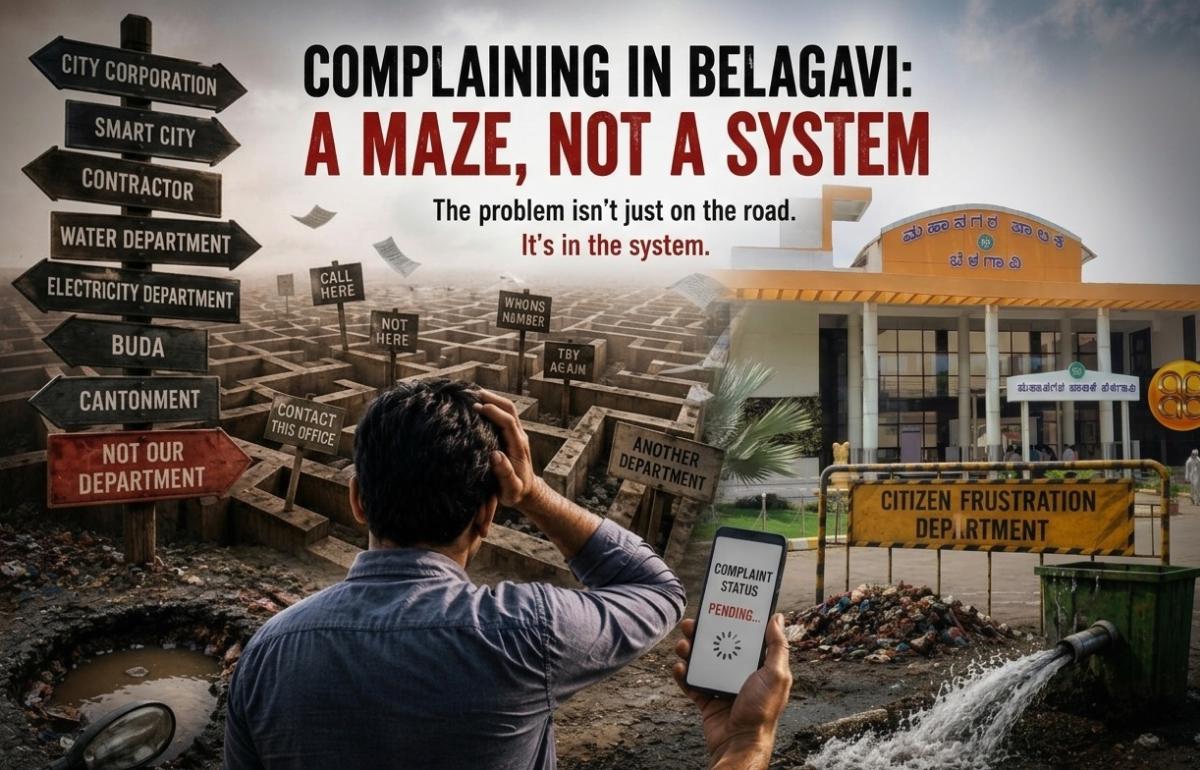
The Endless Circle of “Not Our Department”
The experience is familiar to thousands of residents.
A complaint is lodged with the Corporation.
The response: “It falls under Smart City.”
Smart City says it belongs to a contractor.
The contractor points to another department.
That department redirects the citizen elsewhere.
Days turn into weeks. The issue remains.
The citizen eventually gives up.
The system wins.
This is not an isolated problem. It has become an accepted culture of passing responsibility rather than accepting it.
Smart Infrastructure, Primitive Grievance Handling
Belagavi proudly speaks of Smart City projects, surveillance systems, command centres, digital governance, and technology-driven development.
Yet when a citizen wants to report a broken streetlight or a dangerous pothole, the process still resembles something from two decades ago.
Find the correct number.
Hope somebody answers.
Explain the issue.
Call again.
Follow up.
Submit a written complaint if necessary.
Wait.
And then wait some more.
For a city that aspires to be technologically advanced, the absence of a modern grievance redressal mechanism is both surprising and embarrassing.
Welcome to 2026. Please Hold the Line.
The irony could not be greater.
Artificial Intelligence today can analyse images, generate reports, route service requests, answer complex questions, and automate workflows within seconds.
Across the world, citizens are reporting civic issues simply by uploading a photograph.
AI systems can identify the nature of the problem, determine the responsible department, generate a service ticket, assign it automatically, and provide real-time status updates.
Meanwhile in Belagavi, residents are still searching for phone numbers.
Even worse, they are often searching for the correct phone number.
Why should an ordinary citizen know whether a complaint belongs to the Corporation, Smart City, BUDA, Cantonment authorities, a contractor, the water supply department, or some other agency?
That is an administrative problem, not a citizen’s problem.
Citizens Are Turning to Social Media Because the System Isn’t Listening
An increasing number of residents now post civic complaints on Facebook, WhatsApp groups, Instagram, X, and local media platforms.
Not because they enjoy publicising problems.
But because they believe those platforms offer a better chance of getting attention than official channels.
That should concern every civic authority.
Among public agencies, the Belagavi City Police have demonstrated how digital engagement can work. Their presence on Facebook and X allows citizens to communicate concerns and receive responses.
The question is simple:
Why have other civic bodies not adopted a similar approach?
Why are there no verified and actively monitored grievance handles where citizens can post issues, upload photographs, and receive updates?
In an era where governments promote Digital India, the absence of digital civic engagement at the local level is difficult to justify.
Apps Exist. Results Don’t.
Over the years, several grievance platforms, portals, and complaint systems have been launched.
Yet the public perception remains unchanged.
Citizens often complain that grievances disappear into a digital void. In some cases, complaints are marked as resolved while the issue remains exactly as it was.
A complaint management system is not successful because it closes tickets.
It is successful because it solves problems.
The distinction is important.
One measures administrative paperwork.
The other measures governance.
The City’s Most Neglected Infrastructure
Belagavi’s roads can be repaired.
Streetlights can be replaced.
Drainages can be cleaned.
Water leakages can be fixed.
But unless the city fixes the mechanism through which citizens communicate these problems, every infrastructure investment will continue to be undermined by administrative inefficiency.
The city does not merely need better roads and better drains.
It needs a better way to listen.
One City. One Complaint System.
The solution is neither complicated nor expensive.
Belagavi needs:
- One citywide grievance number.
- One mobile app and web portal.
- One AI-powered civic assistant.
- Automatic routing to the concerned department.
- Photo and location-based complaint registration.
- Public complaint tracking.
- Time-bound resolution deadlines.
- Escalation when deadlines are missed.
- Public dashboards showing pending and resolved complaints.
- Active grievance handling through social media platforms.
Most importantly, the burden of identifying the right department must shift from the citizen to the administration.
The Question Belagavi Must Ask
If Belagavi can build flyovers, command centres, surveillance networks, convention facilities, and multi-crore infrastructure projects, why can it not build a single system that allows citizens to report a civic problem with confidence?
The real measure of urban governance is not how many projects are inaugurated.
It is how quickly and effectively a citizen can get a problem resolved.
Until reporting a civic issue becomes as simple as sending a message, Belagavi’s biggest civic problem may remain the system that is supposed to solve civic problems.
Absolutely. I doubt there’s any city in the country that functions in the suggested way but it’ll be great if Belgavi becomes the first.
This article vents out every Belgaavkar’s outrage. A city that claims to be the winter capital of the state, ranks number 4 in GSDP, where property prices are at par with any other metro city, yet doesn’t have a decent administrative unit that takes accountability. The state should mandate all its serving ministers to stay for one month of a year, in every major city of the state, oversee the administrative mechanism, hear grievances from citizens and recommend changes with fixed deadlines. When lawmakers wants to live in Bengaluru, and only come to Belagavi for kunda purchase, their focus becomes limited to revenue inflow alone.
Relieved to see this issue highlighted! The result is dependence on “jugaad” with money, ” connections”, agents & round about methods to get your legitimate and often very ordinary grievances heard ( let alone settled). With the children away at work it is disheartening to see many senior citizens making rounds of the offices and considering themselves blessed if they can only get a word through even sideways….
I am currently facing a problem due to grave negligence by urban development department. The drainage water from toilets of nearby houses is left to flow openly on a ground near my apartment. I tried raising this with Corporator, civic authorities. But no one is of any help. The problem is still unattended and is creating serious health hazard for the entire locality.
Very true, on that belgaum city corporation tax is increased, with no benefits on ground to any citizens, it has turned into well established corrupted city, a small challenge to all get
e .khata.. with out out paying money.
You have highlighted a most important concern of every citizen.
Sadly the various portals launched with much fanfare by the so called civic departments of the state instead of securing responsibility and accountability have only made it that much more simpler for them to give excuses. Now there is this one more new bureaucratic hurdle the citizen has to overcome with all the older ones.
I don’t see any light at the end of this rabbit hole.
Worst Management of Water Supply.
In the mid of monsoons, the waterman are giving reason of no water in Hidkal.
Looks like the private water suppliers have some tie ups with the waterman.