



The European Roller’s remarkable journey through Belagavi
There are moments in nature when an ordinary morning suddenly becomes extraordinary.
A flash of brilliant blue across an open field. A bird sitting quietly on a bare branch. Then, without warning, a sudden dive towards the ground.
For a few lucky observers around Belagavi, that flash of blue is a remarkable visitor—the European Roller (Coracias garrulus), a migratory bird that has travelled thousands of kilometres to reach the Indian subcontinent.

And it will not be here for long.
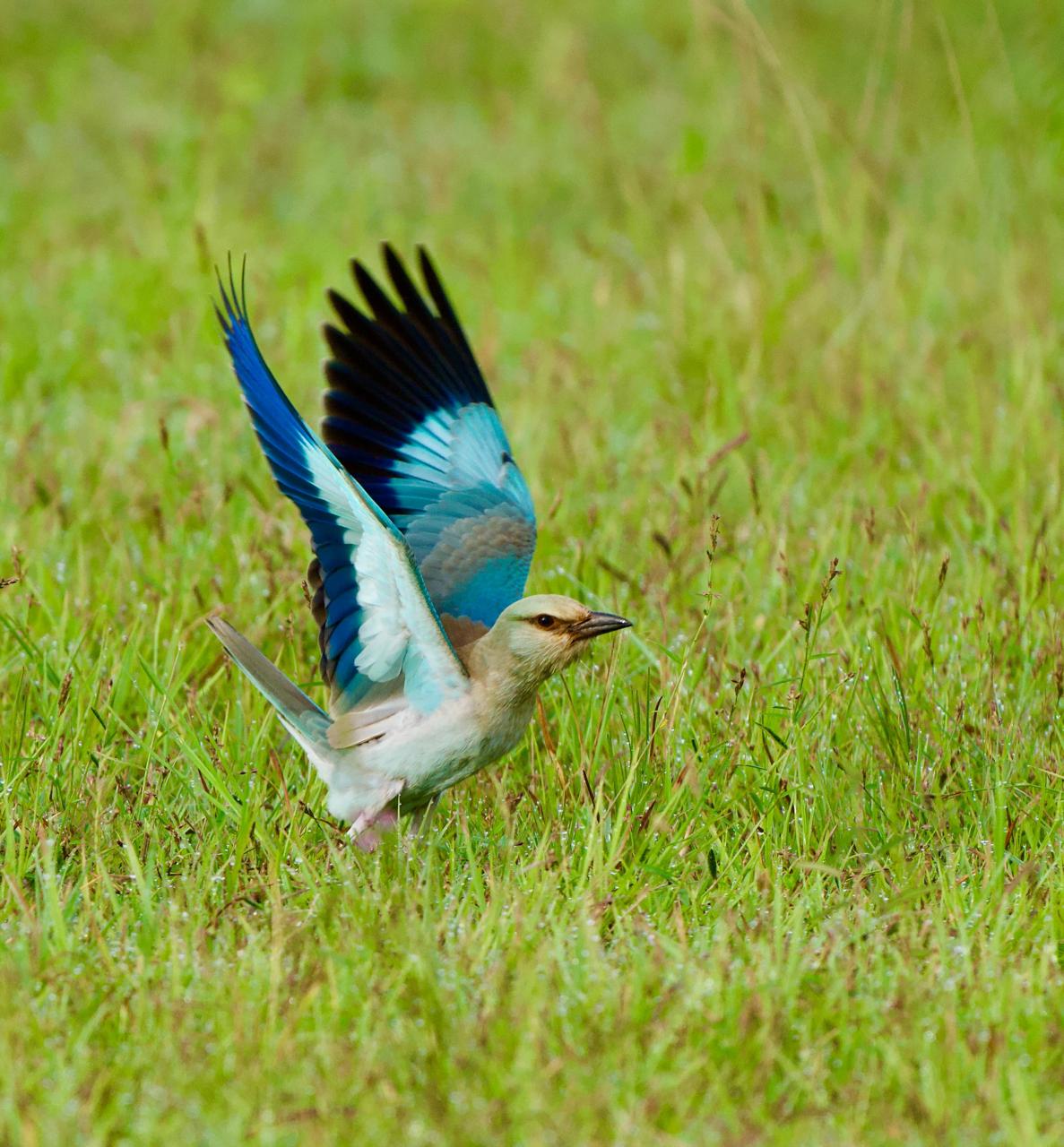
A traveller from Europe
The European Roller breeds across parts of Europe and western and central Asia. As summer ends and autumn approaches, it begins one of nature’s great journeys, leaving its breeding grounds and heading south and southeast.
Its migration takes it through Central Asia and across the Indian subcontinent, with some birds reaching parts of India before continuing towards Africa.
The countryside around Belagavi—with its agricultural fields, open spaces, grasslands and scattered trees—provides suitable stopover habitat for a passing Roller.
Here, the bird can rest, scan the ground for food and replenish its energy before continuing its journey.
Watch the perch
The European Roller is difficult to miss once you know what to look for.
It often sits upright on a prominent branch, pole or electricity wire, patiently surveying the ground below. Then comes the characteristic move—a swift plunge towards the ground to catch insects and other small prey.
Its striking blue plumage makes it particularly spectacular against the earthy browns and greens of the countryside.
But its presence here is more than just a beautiful sight.
Belagavi is only a brief chapter in a journey that spans continents.
From Europe to Africa
The bird’s southward migration can take it from Europe and Central Asia through countries such as Kazakhstan, Afghanistan and Pakistan before reaching the Indian subcontinent.
From here, the journey continues towards Africa, with birds eventually reaching areas of eastern and southern Africa. The Arabian Sea forms another major stretch of this extraordinary journey.
After spending the winter in warmer parts of Africa, the Roller begins the return journey.
Interestingly, the northward route is different.
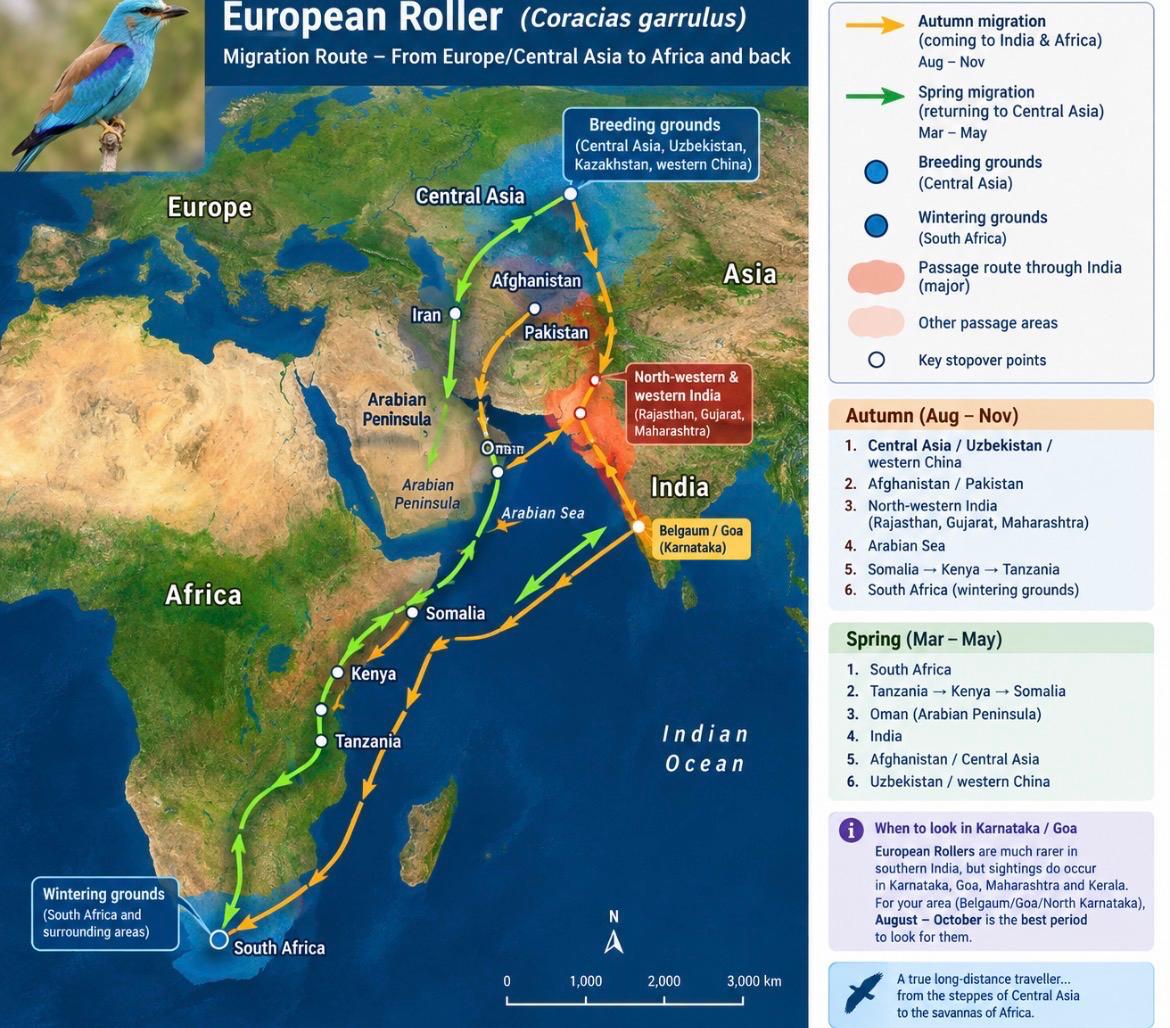
Instead of returning through India, it generally travels north through Africa and the Middle East, crossing regions around Turkey and the Black Sea before reaching Central Asia and eastern Europe—the areas from which its journey began.
A journey without borders
For anyone who watches birds, migration offers a humbling perspective.
These birds recognise no borders, passports or political boundaries. Their world is defined by seasons, food, water and suitable habitat.
Their journeys are written not on political maps, but across landscapes and skies.
And somewhere along that immense route, Belagavi becomes a temporary stopping point.
Look up—you may spot one
So, the next time you are out in the open countryside around Belagavi and notice a brilliant splash of blue among the fields, pause for a moment.
Look closely.
You may not simply be looking at a beautiful bird.
You may be looking at a traveller from another continent—resting briefly in Belagavi before continuing one of nature’s most remarkable journeys.
The European Rollers are expected to remain around for only a few more days.
If you are lucky, you may see one.
The journey in numbers
- Species: European Roller (Coracias garrulus)
- Breeding range: Europe and western/central Asia
- Europe to India: roughly 5,000–7,000 km, depending on the population and migration route
- India to Africa: the south-westward journey continues towards eastern and southern Africa
- Annual round trip: potentially 15,000–20,000 km or more, depending on the individual bird’s breeding and wintering locations
A flash of blue. A brief stop in Belagavi. And then, the journey continues.
About the Author: Dr. Rahul Sathe, a consultant dental surgeon based in Belagavi, is also an avid nature and bird enthusiast. The photographs featured in this article were captured by him during his recent observations of the European Rollers around Belagavi.
I have seen this bird several times in Belgaum. Its beautiful bird blue colored of a pigeon size. I spotted this bird several times in Belgaum. Also I spotted the same bird in Oman as well.