



by Maithily Velangi
This piece was prompted by a recent post on All About Belgaum about the Kala Mandir complex in Tilakwadi finally finding a tenant after remaining largely unused despite its inauguration last year. Reading the update brought back memories of a place that had quietly shaped everyday life in Belagavi – which comprised a market with domestic shops and modest auditorium called Kala Mandir.

Post found on the All About Belgaum website and social media handles,

illustrating the state of the newly inaugurated project.
For those who grew up in the city, walked these neighbourhoods, Kala Mandir was never an ‘architectural landmark’. It was a decent auditorium that hosted annual school functions, music and dance performances, community gatherings, and countless cultural events. It wasn’t spectacular to grab attention, maybe, but it belonged to the city. Over time, as facilities aged and maintenance declined, it gradually lost relevance. Eventually, the neglected and defunct building became a parking space for garbage trucks as per the reports- a sad fate for a place that had once been so full of life.
In 2019, under the Smart City Mission, the site was taken up for redevelopment into a modern commercial complex. The proposal promised a multi-purpose facility with shops, food courts, parking, a multiplex and improved community spaces at a project cost of nearly ₹47 crore. On paper, it represented everything a “modern city” should aspire to become.
However, Kala Mandir was never just the auditorium. It sat within a larger neighbourhood ecosystem. The First Gate vegetable market, small domestic shops, roadside vendors, the familiar chaat stalls, the Sai Baba temple at one end, children with their parents, youngsters with friends, elderly residents- each one engaging in different ways – from buying vegetables, stopping for an evening snack, or a regular temple visit – together they created a place that functioned effortlessly because it had evolved over decades. It was one of those rare neighbourhoods where almost every age group found a reason to be there.
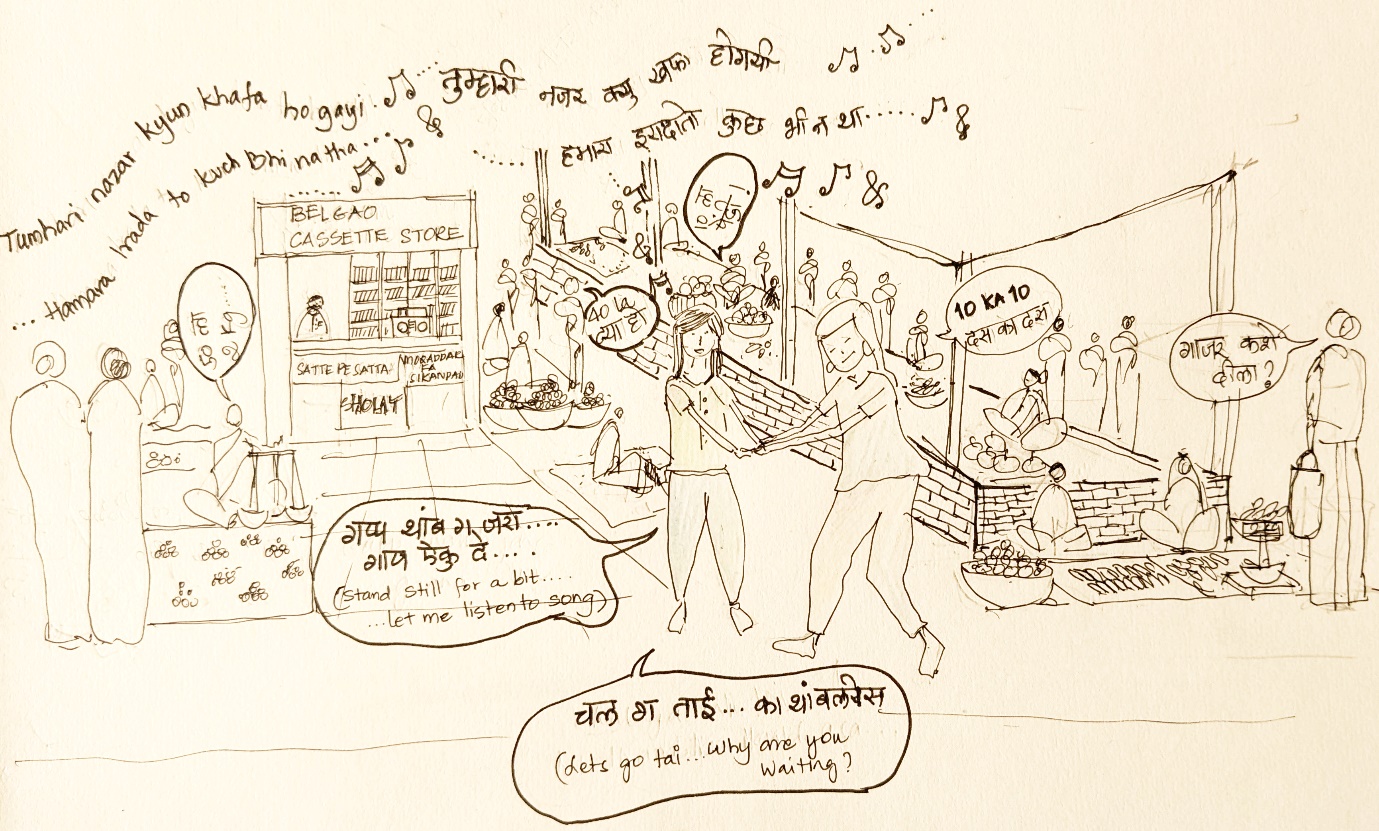
Hand-done illustration of memories (from personal diaries of the author).
A few years back, when I returned there, I captured the site edge, while construction was nearing completion; the contrast was unsettling. The dense web of everyday activities had disappeared behind a solid façade that could easily belong anywhere!
Of course, cities must evolve. Public infrastructure cannot remain frozen in time simply because people hold memories of it. The old Kala Mandir undeniably required attention. But redevelopment should never begin with the assumption that replacing the old automatically creates something better. Instead, the effort to create new can always be looked at as an in-between, where earlier stories continue, making space for newer ones to thrive. The real question is whether we evaluated what was already working before deciding what needed to change.
Could Kala Mandir itself have been restored while upgrading its facilities? Could the market have been modernised without erasing its informal character? Could local traders, residents, performers and neighbourhood users have participated in shaping the redevelopment? These are not nostalgic questions; they are questions about good decision-making by those who have professional powers.
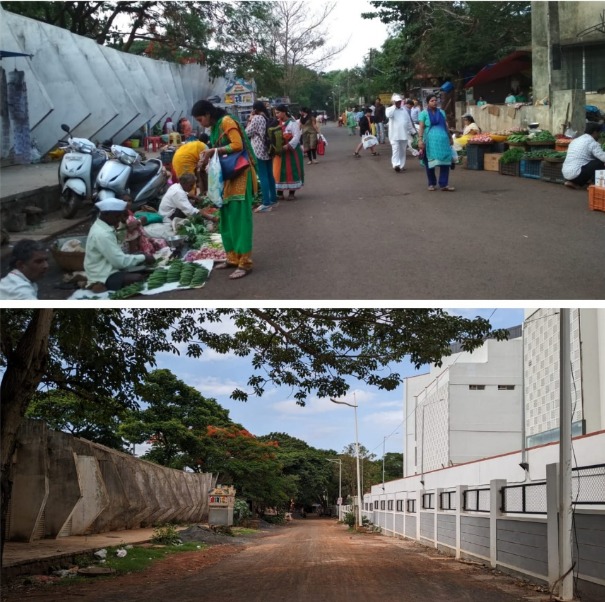
Today, despite years of construction and large public investment, the project has struggled to become the vibrant urban centre that it was proposed to be. The complex, inaugurated in 2025, is yet to start operating.
This is perhaps the lesson that many Smart City projects continue to overlook. Cities are not made smart merely by replacing low-rise neighbourhood spaces with larger buildings. They become better when existing social networks, local economies and collective memories are understood as non-negotiable systems in their own right.
Urban planners, architects and designers increasingly speak about placemaking as an idea from which successful public spaces emerge instead of from any iconic architecture. There is already an awareness among the fraternity that social anchor comes from its everyday use, human interaction and local identity and not by imposition. By that measure, the old precinct in its old form had already achieved something that the new complex may not be able to, given its design, and this, only time will tell.
The redevelopment also came with ecological costs. During the construction phase, concerns were raised over the felling of mature trees on the site, suggesting looking at alternatives such as transplantation, which were perhaps not given much attention and importance.
However, the bigger concern is that projects like these are bringing in homogenous character in Indian cities, without acknowledging their context and neighbourhood identities. Belagavi has always possessed a scale and character that made it different. It would be unfortunate if, in our pursuit of appearing modern, we lose the qualities that made the city memorable in the first place.
As citizens, it is time we ask not only what is being built, but what is being erased in the process – an anchor of shared memories maybe, as I lost mine? Development should certainly improve our cities. But it should also strengthen their identity, not replace it.
And perhaps that is the real conversation that this project leaves us with.
About the Author:
Maithily Velangi, born and brought up in Belagavi, is currently a PhD Student at the Faculty of Architecture, CEPT University, Ahmedabad. With an academic background in Architecture from KLS GIT, master’s in landscape architecture from SPA-New Delhi and a PG Dip. in Environmental Law (NLSIU), her interests lie in the domains of landscape ecologies, particularly at the intersection of land and water boundaries.
(For interested: Do read:https://pulpgr.wixsite.com/pulp/akbaramaranthony – story capturing certain nuances)
Thanks for the write-up and a great illustration!