



The Ganesh Visarjan procession in Belagavi concluded around noon on Sunday after continuing for nearly 42 hours, making it one of the longest immersion processions witnessed in the city. While the festival passed without any major untoward incident, the unprecedented duration has also raised serious questions over the city’s immersion infrastructure, procession management and the responsibility of Ganesha mandals to ensure a smoother flow.
The procession of public Ganesha idols began on Friday evening, September 25, following the customary puja and aarti at Hutatma Chowk. The first immersion began at around 3.30 pm, while the main procession commenced around 5 pm.
This year, 1,056 public Ganesha mandals had installed idols across Belagavi and participated in the 11-day celebrations. Lakhs of devotees from Belagavi and surrounding areas gathered along the procession route, with the crowds swelling through Friday night and continuing into Saturday and Sunday.

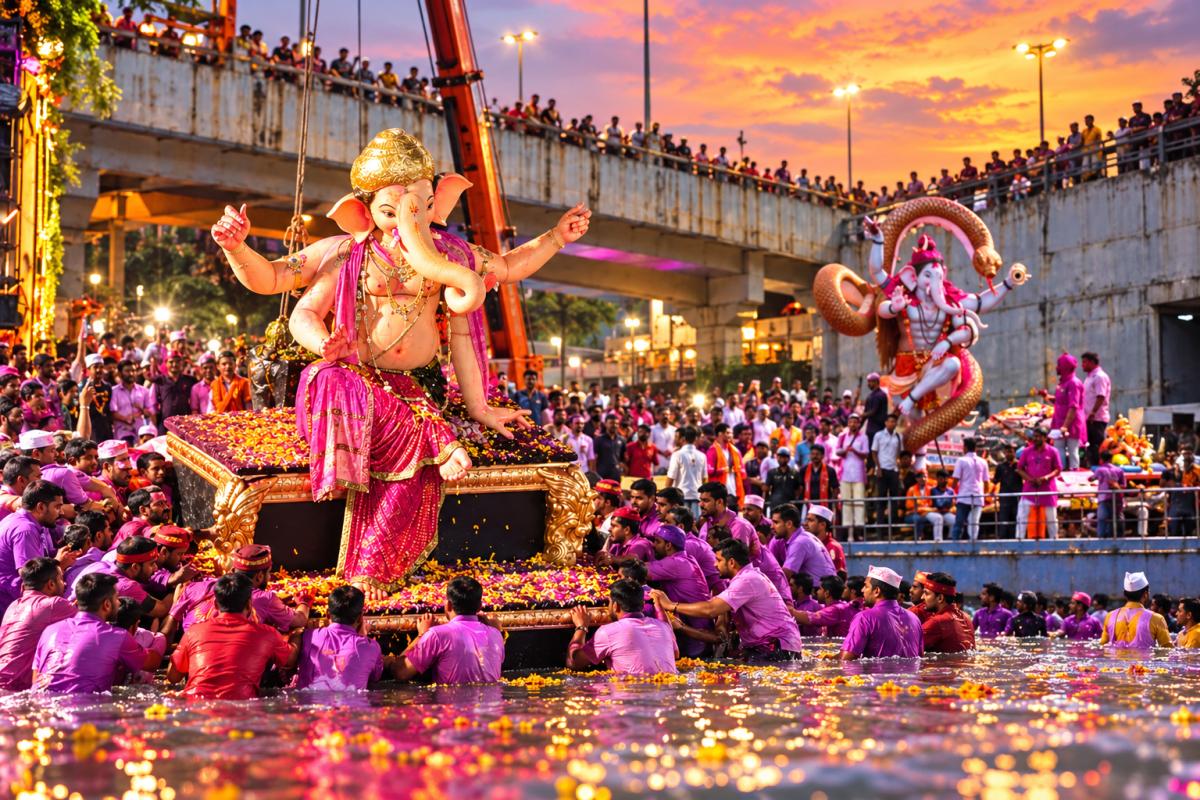
42 hours of pressure on police and administration
The biggest challenge this year was not merely the size of the procession but its duration.
With the immersion continuing through Friday night, the whole of Saturday and into Sunday, police personnel, civic staff, HESCOM employees, emergency teams, traffic personnel and other departments remained deployed for prolonged hours.
More than 4,000 police personnel were reportedly deployed for security and traffic management. The fact that the procession concluded peacefully without any major untoward incident is a significant achievement for the police and district administration.
But a procession stretching to nearly 42 hours also comes at a considerable cost. Police personnel have to maintain barricades, regulate crowds and traffic, provide security at immersion points and remain on duty continuously. The longer the procession continues, the greater the strain on the entire administrative machinery.
This year’s experience therefore needs to be viewed not simply as another record, but as a warning that the existing system is reaching its limits.
Why did the procession take so long?
One of the concerns emerging from this year’s procession is the slow movement of idols towards the immersion points.
The two Kapileshwar immersion ponds — the old and the new pond — remain the principal immersion points for the city’s public Ganesha idols. However, two relatively small immersion ponds are clearly under pressure when more than a thousand public idols have to be processed through them within a limited period.
At the immersion points, each idol has to be brought into position, aarti is performed and the idol is then lowered safely using cranes. Swimmers and life jackets are also deployed as precautionary measures.
Nine cranes were deployed at the two Kapileshwar ponds this year.
Despite these arrangements, the capacity of the two ponds and the time required for each immersion resulted in long queues.
Mandals also need to take responsibility
The administration cannot be held solely responsible for the prolonged procession.
A particularly concerning development this year was that several Ganesha idols were not moved from their respective pandals on Anant Chaturdashi itself. Some mandals reportedly moved their idols only on Saturday evening.
This is deeply disappointing because the entire immersion system is planned around the movement of idols beginning on Anant Chaturdashi.
When idols remain at pandals and are subsequently brought into an already crowded procession on Saturday, the pressure on the immersion points and police deployment increases further.
If the city wants to avoid another 40-plus-hour procession, discipline and coordination among Ganesha mandals will have to be an equally important part of the solution.
Where is the additional immersion capacity?
The most obvious question after this year’s experience is: What is the plan for increasing immersion capacity?
For several years, the administration has spoken about improving immersion arrangements. Yet the two Kapileshwar ponds continue to handle the bulk of the city’s public idols.
If the number of public Ganesha idols remains above 1,000, depending almost entirely on two relatively small immersion ponds is unlikely to provide a sustainable solution.
Rather than waiting for the next Ganeshotsav, the district administration and Belagavi City Corporation need to identify additional immersion locations or create additional dedicated immersion infrastructure well before the next festival.
The objective should not simply be to complete the immersion. It should be to ensure that thousands of devotees, police personnel and civic workers are not forced into a 40-plus-hour operation.
A spectacular procession despite the delays
The procession itself retained its traditional grandeur.
Large crowds gathered along the route as idols arrived at Dharmaveer Sambhaji Circle and other prominent points. Youngsters danced to DJ music while traditional Dhol-Tasha, Dhvaja Pathak, Dollu and Kolata performances added to the atmosphere.
The idols from Chavhat Galli, Khadak Galli, Bandhur Galli, Ganachari Galli and Rajahamsa Galli, Anagol, joined the procession later as per their traditional practice.
The procession finally reached its conclusion with the immersion of the Belagavi City Corporation’s Ganesha idol at Kapileshwar, around noon on Sunday.
No major untoward incident
Considering the massive crowds and the extended duration of the procession, the absence of any major untoward incident is noteworthy.
Police Commissioner Prakash Nikam thanked the people of Belagavi for their cooperation and acknowledged the efforts of police personnel who worked continuously through the procession. He also pointed to the height of some idols and the time required for their movement and immersion as factors contributing to the delay.
The Commissioner also noted that several mandals had reduced DJ sound levels and avoided plasma and laser lighting this year.
City Corporation Commissioner Karthik M. also thanked municipal personnel who worked throughout the extended immersion operation.
The real test begins now
The successful completion of the immersion should not mean that the issue ends with the final idol entering the water.
A 42-hour procession should trigger a detailed review of the entire immersion system.
The administration needs to examine the number and capacity of immersion points, the movement schedule of mandals, idol height and transportation, crane capacity, traffic arrangements and the deployment requirements of police and civic staff.
At the same time, Ganesha mandals must understand that the responsibility for a smooth procession does not rest entirely with the police and administration.
Belagavi has built a reputation for its grand Ganeshotsav. The challenge now is to ensure that the grandeur of the festival does not come at the cost of exhausting police personnel, overburdening civic machinery and leaving thousands of idols waiting for hours to be immersed.
This year’s 42-hour procession should therefore be treated less as a record to celebrate and more as a clear indication that the city’s Ganesh Visarjan system needs additional capacity, better scheduling and greater coordination before next year’s festival.
बेळगांव येथील श्री गणेश चतुर्थी उत्सव हा सर्वांचा सुखकर्ता आणि दुःखहर्ता सण.
त्याहून महत्त्वाचा असतो तो म्हणजे मूर्तिकार मंडळांचे मूर्ती बनवण्यापासून ते स्थापना करण्यापर्यंतचे व देखावे सादर करून योग्यरीतीने विसर्जन मिरवणूक काढून ते मूर्ती शेवट लवकर विसर्जित करण्यापर्यंतची मोठी जबाबदारी पार पाडणे, हे सर्व मंडळांचे कार्य आहे.
जे पोलिस ठाणे मर्यादित आहेत त्यांच्या कडून न हरकत पत्र मिळवणे, सर्व मंडळांना सुलभ करून देण्याची तयारी पोलिस प्रशासन व सर्व कार्यालयांची आहे.
श्री गणेश मूर्ती स्थापनेच्या दिवसापासून ते अनंत चतुर्थीच्या दिवशी योग्य वेळेत मिरवणूक निघेल याची माहिती देण्याकरिता सर्व मंडळांना बांधील केलेतर ह्या सणाला आणि बेळगावच्या परंपरेला नक्की मोठे यश लाभेल.
पोलिस, सरकारी प्रशासन व मंडळाचे वडीलधारी आणि पंच मंडळांनी नक्की पुढाकार घेऊन योग्य नियोजन केले तर यश नक्की मिळू शकते.
गणपती बाप्पा मोरया 🙏🏼 मंगलमूर्ती मोरया 🙏🏼
As mentioned above the capacity of immersion pond should be increased, there is some place available besides the Old Kapileshwar pond which is now currently used as a dump yard. Why don’t the concerned authorities think about extending and improving the capacity of the pond. Also the alternate immersion point Jakkin honda should be examined and it’s capacity should be improved for the support. Also the mandals should coordinate with the administration and follow the procession as planned. The system shouldn’t allow any special convenience to any mandals and try to complete the procession as early as possible. As said 42 hrs shouldn’t be looked as a record, but should be reason to worry.