



Belagavi FAQ
Belagavi, also known as Belgaum, is a historic city in north-western Karnataka known for its pleasant climate, rich cultural heritage, educational institutions, foundry industry, military establishments and distinctive food traditions. Located near the Karnataka–Maharashtra border, the city has a multilingual population and strong cultural and economic connections with neighbouring regions.
This guide answers frequently asked questions about Belagavi’s history, food, tourism, industries, education, transport, civic infrastructure, culture and everyday life. It is intended as a practical starting point for residents, visitors, students, businesses and anyone looking to understand the city better.
Table of Contents
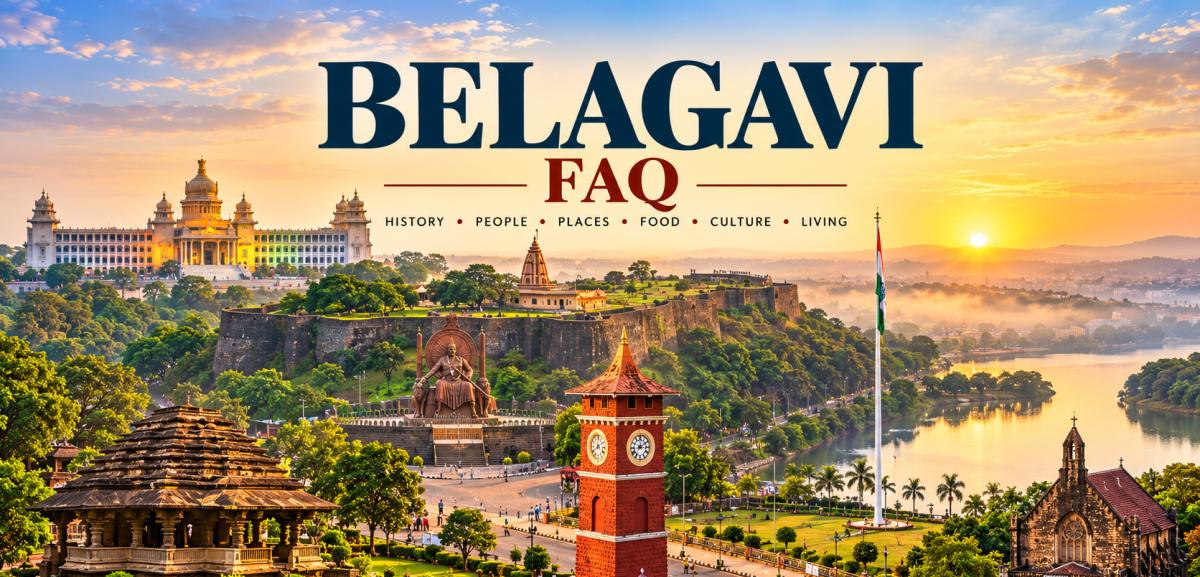
Belagavi FAQ | About Belagavi
1. What is Belagavi famous for?
Belagavi is known for its traditional sweet, Kunda; its foundry and engineering industries; educational and healthcare institutions; military establishments; historic monuments; and distinctive cultural traditions. The city is also associated with the 1924 Indian National Congress session presided over by Mahatma Gandhi.

Its location near Maharashtra and Goa gives Belagavi a distinctive regional character, reflected in its food, languages, trade and festivals.
2. Why is Belagavi also called Venugram?
Venugram is a traditional name associated with Belagavi. The name is commonly explained through the Sanskrit word venu, meaning bamboo, and gram, meaning village. The name is therefore associated with the idea of a village of bamboo.
Belagavi has been known by different names through its history. Read more in All About Belagavi’s article on the different names of the city.
3. Is Belagavi the second capital of Karnataka?
Belagavi is often described as Karnataka’s second capital because the state government holds its annual winter legislative session at the Suvarna Vidhana Soudha in the city. However, this popular description should not be confused with a formal constitutional designation of Belagavi as a second capital.
The winter session brings legislators, ministers and government officials to Belagavi and gives the city an important role in the administration of North Karnataka.
4. What is the history of Belagavi?
Belagavi has a long history shaped by several ruling dynasties and political powers. Its heritage includes the Ratta period, medieval fortifications, religious monuments and later Maratha and British-era influences.
The city’s historic identity is visible in Belagavi Fort, Kamal Basadi, old neighbourhoods, religious structures and the Cantonment. Its modern history also includes the 1924 Indian National Congress session presided over by Mahatma Gandhi.
5. Why is Belagavi known for its climate?
Belagavi is widely known for a relatively pleasant climate compared with many hotter parts of the Deccan plateau. Its elevation and seasonal monsoon influence contribute to its weather.
Conditions vary by season, and temperatures can rise during summer. Anyone planning a visit should check the current forecast rather than rely solely on the city’s reputation for pleasant weather.
6. Is Belagavi a good city to live in?
Belagavi can offer a balance of urban amenities and a comparatively relaxed lifestyle. It has schools, colleges, hospitals, markets, recreational spaces and established residential neighbourhoods. Housing and everyday expenses may also be lower than in some larger metropolitan cities, depending on the locality and lifestyle.
However, residents also face challenges involving traffic, parking, public transport, road maintenance, water supply and waste management. Career opportunities in certain high-paying corporate and technology roles may be more limited than in larger employment centres.
Food and local specialities
7. What food is Belagavi famous for?
Belagavi is especially famous for Kunda, a traditional milk-based sweet. Other local food traditions include Mande or Mandige, a thin layered sweet preparation, Alepaak or Alipaak, and a variety of biryanis and regional snacks.
The city’s food culture reflects influences from Karnataka, Maharashtra and neighbouring regions. Recipes, names and preparation styles can vary between families and establishments.
For more on Alepaak, read All About Belagavi’s report on this local speciality.
8. What is Belagavi Kunda?
Kunda is a signature sweet associated with Belagavi. It is traditionally prepared by reducing milk and cooking it with sugar until it develops a rich, caramelised flavour and a distinctive grainy texture.
Kunda is closely associated with the city’s food identity and is commonly bought by visitors as a local speciality to take home.
Read more: Belagavi’s Kunda — the sweet sensation.
9. Where can people shop in Belagavi?
Belagavi has several established shopping areas, each with its own character. Ramdev Galli, Khade Bazar, Bhendi Bazar, Raviwar Peth and Maruti Galli are known for traditional retail and commercial activity. Shahpur and Mahatma Phule Road have their own established shopping and trading networks, while Dr B. R. Ambedkar Road and Tilakwadi serve shoppers in other parts of the city.
Wholesale trading, including grain and other commodities, is associated with parts of Raviwar Peth and the Kalmath Road area. Modern supermarkets and shopping outlets provide additional options.
The best shopping destination depends on whether the requirement is clothing, jewellery, household goods, groceries, wholesale purchases or everyday retail.
Further reading: Belagavi’s Golden Quadrangle and We Are Like This Only — Part 2.
Tourism and heritage
10. What are the main tourist attractions in Belagavi?
Some of Belagavi’s best-known attractions include:
- Belagavi Fort: A historic fort complex with religious and architectural landmarks.
- Kamal Basadi: A notable Jain temple associated with the city’s medieval history.
- Fort Lake: A familiar urban landmark and recreational area.
- Rajhans Gad or Yellur Gad: A hill fort in the surrounding region, offering historical interest and views.
- Historic neighbourhoods and religious sites: These provide glimpses of Belagavi’s architectural and cultural past.
Visitors can also plan excursions to places in the wider Belagavi region. Check local access, opening arrangements and weather before travelling.
Explore more in Best Places to Visit in Belagavi and One-day trip spots near Belagavi.
11. What is Kamal Basadi?
Kamal Basadi is a historic Jain temple located within the Belagavi Fort complex. It is associated with the Ratta period and dates to the early thirteenth century, with 1204 commonly cited in accounts of its history.
Dedicated to the Jain Tirthankara Neminatha, the temple is recognised for its architectural features and historical significance. It is one of the important heritage landmarks within the city.
12. What are some lesser-known places to explore in Belagavi?
Beyond the best-known attractions, Belagavi has older neighbourhoods, historic buildings, religious sites and public institutions worth exploring. These include heritage structures in Shahpur, the Native General Library, established in the nineteenth century, and sites associated with the city’s religious and social history.
Rangubai Palace, Baragada Bhavi and other locally known heritage locations are also mentioned in accounts of the city. Their present condition, accessibility and visitor arrangements should be checked before planning a visit.
For historical context, see Re-exploring Venugram.
13. What is special about Belagavi Cantonment?
Belagavi Cantonment is an important military and heritage area known for its tree-lined roads, institutional establishments, older buildings and religious landmarks. It forms a distinct part of the city’s urban character.
The Cantonment has a long history dating to the nineteenth century. It is also associated with military training and establishments in and around Belagavi. As a military area, access to certain locations may be restricted, and visitors should follow all applicable rules.
For historical background, see All About Belagavi’s article on the establishment of the military station.
14. What is the Suvarna Vidhana Soudha?
The Suvarna Vidhana Soudha is a major government and legislative building in Belagavi. It was inaugurated on 11 October 2012 by then President of India Pranab Mukherjee, as part of the Golden Jubilee celebrations marking the formation of Karnataka.
The building hosts the state legislature’s winter session and serves as a prominent symbol of the government’s engagement with North Karnataka.
Its significance is both administrative and symbolic: it brings legislative proceedings to Belagavi and reinforces the city’s role in the state’s public life.
Education, healthcare and employment
15. Why is Belagavi considered an educational hub?
Belagavi has a substantial educational ecosystem serving students from the city and surrounding districts. Its institutions cover engineering, medicine, law, science, commerce, arts, pharmacy and other professional disciplines.
Important institutions include Visvesvaraya Technological University (VTU), Rani Channamma University (RCU), KLE Academy of Higher Education and Research (KAHER), Jawaharlal Nehru Medical College and a range of other colleges, schools and technical institutions.
The presence of these institutions attracts students from across Karnataka and neighbouring states.
16. Is Belagavi a healthcare hub?
Belagavi serves as an important healthcare centre for people from the city and surrounding parts of North Karnataka, as well as neighbouring areas. Its healthcare network includes government hospitals, medical college hospitals, teaching institutions, private hospitals, specialist clinics and diagnostic centres.
Major institutions include KLE Dr Prabhakar Kore Hospital and Medical Research Centre and the Belagavi Institute of Medical Sciences (BIMS), along with other private and public healthcare providers.
For emergency care or specialised treatment, patients should contact the relevant hospital directly to confirm the services and facilities available.
17. What industries are important to Belagavi?
Belagavi has a diverse industrial base. Its important sectors include:
- Foundries and precision engineering
- Aerospace manufacturing
- Sugar and agro-processing
- Textiles and powerloom weaving
- Engineering and manufacturing
- Agriculture and related industries
- Emerging technology and IT services
The city’s industrial character is supported by its regional connectivity, technical education institutions, manufacturing experience and surrounding agricultural economy.
18. Why is Belagavi known for its foundry industry?
Belagavi has an established foundry and engineering cluster that supplies castings and components for industrial and automotive applications. Foundries form an important part of the local manufacturing ecosystem and support a network of ancillary engineering businesses.
The industry provides skilled and technical employment and connects local manufacturers with customers beyond the region. Exact figures for the number of operating foundries, annual production and employment vary by year and source, so dated industry statistics should be used when quoting numerical claims.
19. What is the Belagavi Aerospace Cluster?
The Belagavi Aerospace Cluster (BAC), associated with Aequs, is an industrial ecosystem focused on aerospace and precision engineering manufacturing. It brings together manufacturing capabilities and suppliers within a specialised industrial setting.
The cluster is significant because aerospace manufacturing requires high levels of precision, quality control, technical skills and compliance with demanding industry standards. It also adds to Belagavi’s potential to attract specialised manufacturing investment.
Claims about the cluster’s exact area, number of units and national “first” status should be tied to current official or company documentation.
20. Is Belagavi known for textiles and saree weaving?
Belagavi and its surrounding areas have a tradition of textile activity, including saree weaving and powerloom operations. Shahpur is among the localities associated with this heritage.
The sector has evolved over time in response to changing markets, production methods and competition. While traditional textile knowledge remains part of the region’s identity, current employment and loom figures should be verified before publication.
21. Why is Belagavi important for the sugar industry?
The wider Belagavi district is an important sugarcane-growing and sugar-processing region. Sugar factories, agricultural supply chains and related businesses play a role in the local economy.
The sector also has links to by-products and allied activities, including bagasse-based power generation and ethanol production. Its scale is influenced by rainfall, irrigation, sugarcane yields, market conditions and government policy.
District-level sugarcane area, factory numbers and production rankings should be quoted only with a clearly identified reporting year and an official or industry source.
22. Are there IT and technology jobs in Belagavi?
Belagavi has a growing technology and entrepreneurship ecosystem, supported by engineering colleges, local technology companies and industry networks such as BeTCA.
However, the range and number of technology jobs available locally may be smaller than in major IT centres such as Bengaluru or Pune, particularly for specialised roles and senior positions. Local opportunities can include software development, IT services, engineering, digital marketing, product development and business support.
People seeking technology careers should compare the current local job market with opportunities in larger cities and remote-work arrangements.
23. Why do some people move from Belagavi to other cities for jobs?
Some residents move to larger employment centres because those cities offer a wider range of corporate roles, technology jobs, higher-paying positions and specialised career paths. Bengaluru, Pune and Mumbai are among the destinations that attract people seeking such opportunities.
This does not mean Belagavi lacks employment. Manufacturing, healthcare, education, agriculture, retail, professional services and local businesses continue to provide work. Expanding higher-value industries and supporting local entrepreneurship could help retain more skilled workers.
Transport and connectivity
24. How is Belagavi connected to other cities?
Belagavi is connected by road, rail and air. Road links connect it with cities and towns in Karnataka and neighbouring states. Rail services provide access to a range of destinations, while Belagavi Airport at Sambra offers air connectivity.
The convenience of a journey depends on the destination, service frequency and current timetable. Travellers should check railway schedules, bus operators and airline websites before making plans.
25. Which flights operate from Belagavi Airport?
Belagavi Airport at Sambra serves the city and surrounding region. Airline routes and frequencies can change with seasonal schedules and commercial decisions.
According to the published winter schedule reported by All About Belagavi in October 2026, IndiGo was scheduled to operate direct services to Bengaluru, Hyderabad, Navi Mumbai and Delhi, with different frequencies for each route. The reported schedule included changes taking effect from late October 2026.
These are schedule-dependent details, not a permanent list of routes. Passengers should verify operating days, flight times and availability directly with the airline before booking.
Read the latest report: IndiGo cuts Belagavi–Delhi flights to three a week in the winter schedule.
26. Does Belagavi have good public transport?
Belagavi has public bus services and other forms of local transport. However, the experience can vary by route, time of day and neighbourhood. Concerns raised by residents include bus frequency, capacity, connectivity between residential areas and commercial centres, and access for students and commuters.
Improving route planning, service frequency, passenger information and last-mile connectivity would make public transport more useful for everyday travel.
Civic infrastructure and urban development
27. What are the major civic challenges in Belagavi?
Commonly discussed civic issues include traffic congestion, parking shortages, road maintenance, footpath conditions, drainage, solid-waste collection, public transport and reliable water supply.
The scale of each issue varies across neighbourhoods and can change as projects are completed or new problems arise. Effective solutions require coordinated planning, transparent project monitoring, timely maintenance and public participation.
28. Is traffic and parking a problem in Belagavi?
Traffic and parking are recurring concerns in busy commercial areas and on roads that carry a high volume of local movement. Traditional market streets, roadside parking, loading and unloading, pedestrian movement and limited dedicated parking can contribute to congestion.
Better parking management, enforcement, pedestrian infrastructure, public transport and planning for commercial deliveries can help improve movement through the city.
29. How is Belagavi’s water supply managed?
Belagavi’s water supply is linked to sources including the Rakaskop and Hidkal reservoirs. The reliability of supply depends on reservoir levels, rainfall, pumping and distribution infrastructure, demand and the performance of the water-supply network.
The city has also been associated with a 24×7 water-supply project. Project execution, leakage control, road restoration and service reliability are important issues for residents.
Water availability can change significantly with the season. For current shortages, supply schedules and project updates, readers should refer to the latest municipal announcements and local reporting rather than rely on older reservoir estimates.
30. What are the waste-management issues in Belagavi?
Solid-waste management involves household collection, transportation, segregation, processing and disposal. Residents have raised concerns in some localities about missed collections, collection frequency and the handling of waste in public spaces.
Improving segregation at source, collection reliability, processing capacity and public awareness is important for a cleaner city. Reports about new facilities or municipal initiatives should be checked against current implementation status.
31. What is needed for Belagavi’s future growth?
Belagavi’s future growth depends on creating employment, supporting manufacturing and technology businesses, improving infrastructure and making urban development more sustainable.
Priorities include better roads and public transport, dependable water and waste services, efficient approvals for businesses, investment in skills, support for local entrepreneurs and protection of productive agricultural land. Development should be guided by transparent planning and the needs of both existing residents and future generations.
Agriculture, markets and regional economy
32. What crops are grown in Belagavi district?
Agriculture in the wider Belagavi district includes sugarcane, maize, paddy, jowar, vegetables and other crops. The crop mix varies by taluk and depends on rainfall, irrigation access, soil conditions and market demand.
Sugarcane is particularly important to the region’s sugar-processing economy. District-level crop area and production figures should be referenced to a specific agricultural year and official statistics.
33. What makes Belagavi’s markets distinctive?
Belagavi’s markets combine long-established trading streets, wholesale businesses, specialised retailers and modern stores. Traditional commercial areas remain important for clothing, household goods, jewellery, food products and other everyday purchases.
The city’s location near state borders also contributes to regional trade and a varied consumer market. For visitors, the best area to shop depends on the product and whether the purchase is retail or wholesale.
Culture, festivals and notable personalities
34. Which languages are spoken in Belagavi?
Belagavi is multilingual. Kannada and Marathi are widely used, while Hindi, Urdu, English and other languages are also spoken by different communities.
Language use varies by family, neighbourhood, institution and workplace. This multilingual character reflects the city’s location and long-standing cultural and commercial connections with neighbouring regions.
35. What is Durga Mata Daud in Belagavi?
Durga Mata Daud is a distinctive Navaratri devotional tradition associated with Belagavi. It involves devotees gathering for an early-morning devotional run during the festival period. Participants, often referred to locally as Dharkaris, take part in an organised procession marked by devotion and a strong community atmosphere.
The event has become a recognisable part of Belagavi’s Navaratri celebrations, drawing participants and onlookers from different parts of the city. Reported participation figures can vary by year and should be treated as estimates unless confirmed by organisers.
Read more: Durga Mata Daud in Belagavi — a Navaratri devotional run.
36. Who was Gangadhar Rao Deshpande?
Gangadhar Rao Deshpande, often known as the “Lion of Karnataka”, was a freedom movement leader born in Hudli in 1871. He played an important role in the nationalist movement and was closely associated with the organisation of the 1924 Indian National Congress session in Belagavi.
Deshpande supported Swadeshi, khadi and constructive social work. His life links Belagavi’s regional history with the wider Indian independence movement.
37. Why is Hudli historically important?
Hudli, a village near Belagavi, is associated with khadi, constructive work and the freedom movement. It is connected with Gangadhar Rao Deshpande and the activities of the Khadi Gramodyog Sahakari Sangh.
Hudli also hosted a gathering of the Gandhi Seva Sangh in 1937, associated with the wider effort to promote village industries and constructive programmes. The village remains an important part of the region’s freedom movement history.
38. When did Swami Vivekananda visit Belagavi?
Swami Vivekananda visited Belagavi in 1892, before his journey to the West. Accounts preserved by All About Belagavi describe his stay at the home of Sadashiv Bhate in Risaldar Galli and a subsequent stay at the residence of Haripada Mitra.
The visit is remembered through local accounts and the Ramakrishna Mission’s association with the place where Vivekananda stayed. Published accounts differ in how they describe the duration and sequence of his stay, so exact day counts should be read in the context of those historical sources.
Read more: Swami Vivekananda and his Belagavi visit and Stories of people who met Swami Vivekananda in Belagavi.
39. Who was Kittur Rani Chennamma?
Kittur Rani Chennamma was a ruler who led an armed resistance against the British East India Company in 1824. The conflict followed a dispute over the succession to the Kittur throne after the adoption of Shivalingappa.
British forces fought the Kittur state, and the conflict resulted in Chennamma’s capture and imprisonment. She died in captivity at Bailhongal in 1829. Sangolli Rayanna continued resistance after her capture and was executed in 1831.
Rani Chennamma remains an important figure in Karnataka’s history and is remembered through memorials, public commemorations and the annual Kittur Utsav.
40. What is Belagavi’s connection with the 1924 Congress session?
Belagavi hosted the Indian National Congress session on 26 and 27 December 1924, with Mahatma Gandhi presiding. The gathering was a significant event in the city’s history and brought national political leaders and delegates to the region.
The session was held at a specially prepared venue and involved substantial arrangements for visitors. It remains an important part of Belagavi’s association with India’s freedom movement.
Read the detailed local account: The 1924 Belgaum Congress Session.
41. What is Belagavi known for in sports?
Belagavi has a sporting culture that includes swimming, roller skating, wrestling, cricket and bodybuilding, among other disciplines. Local clubs, training centres and educational institutions contribute to sports participation.
The city and district have produced athletes who have competed at different levels. Individual records, national or international titles and world-record claims should be verified against the relevant sporting organisation before being quoted.
Practical information
42. Is Belagavi suitable for a short visit?
Belagavi can be explored over a short visit, depending on the traveller’s interests. A city-focused itinerary could include Belagavi Fort, Kamal Basadi, Fort Lake and selected heritage sites. Travellers with more time can consider nearby hill forts and other destinations in the wider region.
Opening arrangements, travel times and accessibility vary, so it is sensible to check current local information before setting out.
43. Is Belagavi less expensive than Bengaluru?
Belagavi may be more affordable than Bengaluru for some everyday expenses, particularly depending on housing, commuting and lifestyle choices. However, there is no single cost-of-living figure that applies to everyone.
Rent, school fees, healthcare, transport and household spending vary by neighbourhood and family requirements. Comparisons should use current prices and equivalent standards of living.
44. Where can visitors find reliable information about Belagavi?
Visitors and residents can use official government websites for administrative services, transport operators for schedules, airlines for flight information and relevant institutions for their current facilities and timings.
All About Belgaum also publishes local news, civic updates, historical features, city guides and event coverage. For time-sensitive matters such as flight schedules, water supply, traffic restrictions or public notices, readers should check the latest report or official announcement rather than an older article.
About All About Belgaum
All About Belgaum is a local news and information platform covering Belagavi and the surrounding region. Its coverage includes civic issues, infrastructure, education, business, culture, tourism, public events and local developments.
This FAQ makes useful information about Belagavi easier to find and understand. The page will be updated as projects progress, services change and additional historical and local information is verified.
Last reviewed: October 2026. Transport schedules, civic project status, statistics and other time-sensitive information may change after this date. Readers should consult the latest linked reports or official sources for current details.